


Close Menu
  • Home
  • News
    • Local
  • Opinion
  • Business
  • Health
  • Education
  • Sports
  • Podcast

Subscribe to Updates

Get the latest creative news from FooBar about art, design and business.

What's Hot

Latinas Deserve Equal Pay. Unions Help Make It Happen.

Houston’s ‘call Me Mother’ Exhibit Opens Today, Spotlighting Black Maternal Health

Should You Have to Pay to Hear the Gospel?

Facebook X (Twitter) Instagram
  • Lifestyle
  • Podcast
  • Contact Us
Facebook X (Twitter) Instagram Pinterest Vimeo
The Windy City Word
  • Home
  • News
    1. Local
    2. View All

    Youth curfew vote stalled in Chicago City Council’s public safety committee

    Organizers, CBA Coalition pushback on proposed luxury hotel near Obama Presidential Center

    New petition calls for state oversight and new leadership at Roseland Community Hospital

    UFC Gym to replace shuttered Esporta in Morgan Park

    Houston’s ‘call Me Mother’ Exhibit Opens Today, Spotlighting Black Maternal Health

    Morehouse School of Medicine Fall Convocation Has Strong Ties to Nashville

    OP-ED: Proposition 44 Would Put a Price on Trust

    Jaguars Do Better: Top of Ladder or Resting at the Bottom

  • Opinion

    Rep Davis, Olive Post CDR., Call on Trump to Restore file of Black Vietnam War Hero to Website

    Capitalize on Slower Car Dealership Sales in 2025

    The High Cost Of Wealth Worship

    What Every Black Child Needs in the World

    Changing the Game: Westside Mom Shares Bally’s Job Experience with Son

  • Business

    Illinois Department of Innovation & Technology supplier diversity office to host procurement webinar for vendors

    Crusader Publisher host Ukrainian Tech Businessmen eyeing Gary investment

    Sims applauds $220,000 in local Back to Business grants

    New Hire360 partnership to support diversity in local trades

    Taking your small business to the next level

  • Health

    Houston’s ‘call Me Mother’ Exhibit Opens Today, Spotlighting Black Maternal Health

    Morehouse School of Medicine Fall Convocation Has Strong Ties to Nashville

    OP-ED: Proposition 44 Would Put a Price on Trust

    Cuts and Conversations Turns Barber Chairs into Space for Lifesaving Dialogue

    A $2.1 Trillion Wellness Industry Never Built a Daily Practice for Black Children. So This Atlanta Family Did.

  • Education

    Author Kristen Amundson Explains ‘The Grandparent Effect’ and How It’s Helping Children Thrive Through Love, Support, and Connection

    Responsible AI Development Requires a Seat at the Table for Black America

    COMMENTARY: Being Frank: a Safe Place

    Outnumbered: Elbert Cox’s Equation for Greatness

    Gov. Newsom’s Latest Appointees Include Sacramento Advocate for Formerly Incarcerated Students; State’s New Tech Chief

  • Sports

    Jaguars Do Better: Top of Ladder or Resting at the Bottom

    NFL: Bryce Young is Proving “Patience is a Virtue”

    WNBA Playoffs: DeWanna Bonner and Atlanta Dream dominate on defense, Win Game 1

    Angel Reese Wins 2026 WNBA Defensive Player of the Year

    A Viral Moment with Purpose: Keep Your Head Up Gives Back

  • Podcast
The Windy City Word
Local

Northwestern performs first heart transplant in Illinois using ‘heart-in-a-box’ device

staffBy staffUpdated:No Comments5 Mins Read
Facebook Twitter Pinterest Telegram LinkedIn Tumblr Email Reddit
Share
Facebook Twitter LinkedIn Pinterest WhatsApp Email

For the first time in Illinois, surgeons have successfully taken a heart that stopped beating inside a patient and transplanted it into another person with the help of a new, science fiction-like device.

Surgeons at Northwestern Memorial Hospital announced Wednesday that they performed a heart transplant Oct. 12 using a machine nicknamed “heart in a box.” It’s an advance that doctors hope will make more hearts available for transplant. About 3,400 people across the country are now waiting for heart transplants, including 182 in Illinois.

Advertisement

Usually, hearts are only considered for transplant if a donor suffers brain death but the donor’s heart is still beating in their body, either on its own or with mechanical assistance. That can sometimes happen after a traumatic injury or drug overdose. In those cases, the heart is removed from the donor’s body and put on ice for transport to a recipient, which must occur within about four hours.

The heart in a box device, however, allows surgeons to use hearts from donors who suffer circulatory death, which is when the heart and respiratory system shut down. After the heart stops beating, surgeons have about 30 minutes to retrieve it and place it in the device. The device then resuscitates it and keeps it beating by pumping warm, oxygenated blood through it, until it can be transplanted into a donor.

Advertisement

The patient who received the heart at Northwestern is doing well, and was preparing to go home early this week, said Dr. Benjamin Bryner, associate director of heart transplantation and mechanical support, and director of the expanded donation program at Northwestern Medicine’s Bluhm Cardiovascular Institute.

“I think it’s one of the most significant advances in heart transplant in a few decades,” Bryner said. “It opens up a lot of hearts that were sort of discarded.”

Bryner estimates the device could increase the number of heart transplants by about 20% to 30% at Northwestern and across the country. Northwestern now performs about 30 to 40 heart transplants a year, Bryner said.

Until now, patients usually could not be considered as potential donors unless they were brain dead, limiting the number of hearts available. The new technology allows surgeons to take hearts from patients who are not technically brain dead, but have no hope of recovery. Those patients may also have suffered a traumatic injury or drug overdose, and have lost nearly all brain function, but aren’t considered brain dead because they may have a reflex still intact or a small trickle of blood flow into the brain, Bryner said. They’re not considered as donors unless there’s no hope left, he said.

If a patient reaches that point, the patient’s family can make a decision to take the person off life support, so they stop breathing and their heart stops beating. The person then suffers circulatory death, and surgeons can retrieve the heart and place it in the device to be transported to another patient.

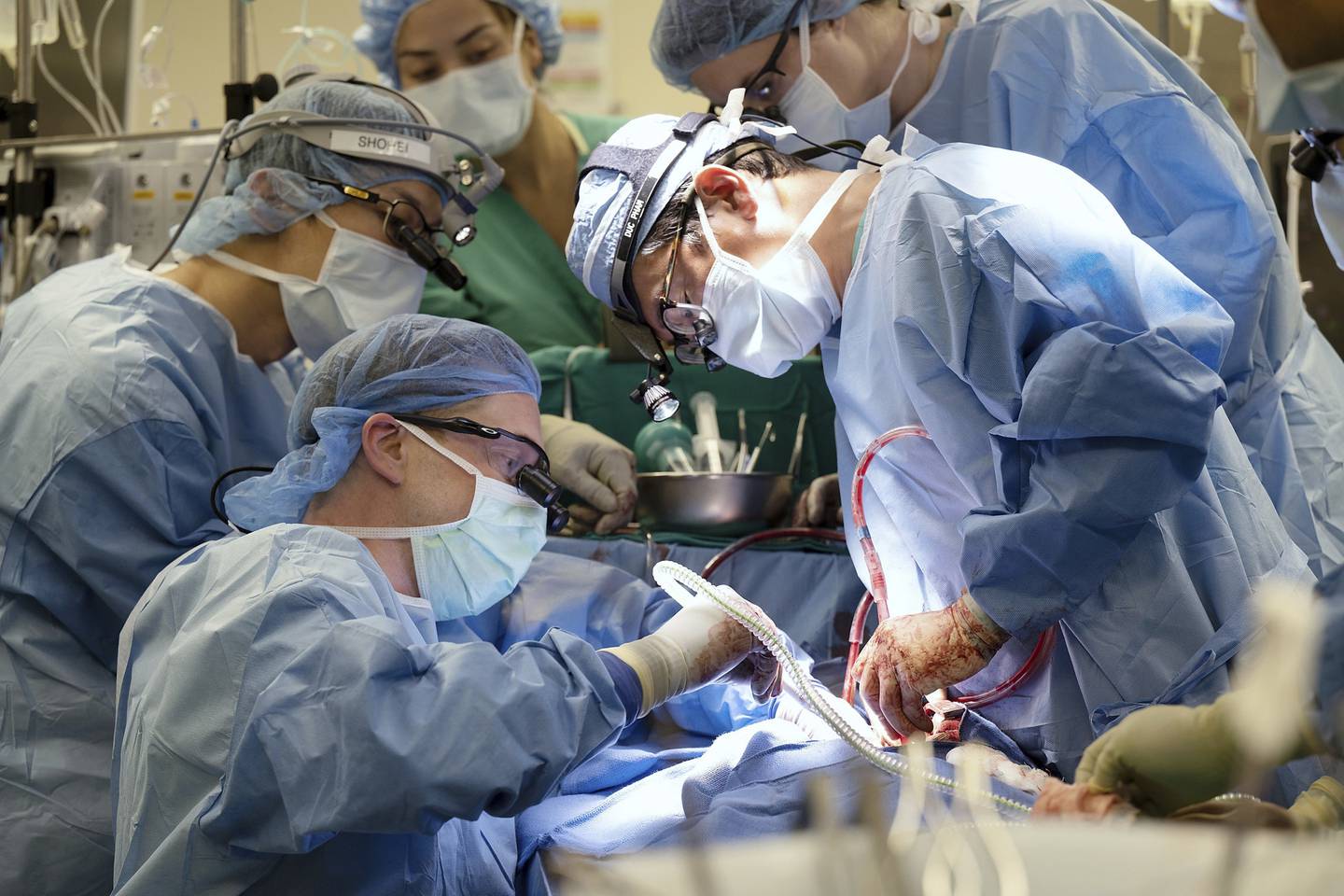
Dr, Benjamin S. Bryner, associate director of heart transplantation (bottom), and Dr. Duc Thinh Pham, director of heart transplantation and mechanical circulatory support (top), are shown performing a transplant using a heart donated after circulatory death (DCD). The surgery was the first DCD heart transplant in Illinois, performed at Northwestern Memorial Hospital on Oct. 12, 2022. (Northwestern Medicine)

Because the device keeps the heart pumping, surgeons have more time to transplant it than with traditional methods. The device can keep the heart viable for eight or nine hours, compared with about four or five hours when a stopped heart is on ice before a transplant.

“With the traditional methods we’re limited in terms of amount of time and distance we can travel,” said Dr. Duc Thinh Pham, director of heart transplantation and mechanical circulatory support at Northwestern’s Bluhm Cardiovascular Institute. “This device allows us to travel further distances and for (a longer) travel period.”

The device also gives surgeons more time to examine a heart’s condition, searching for signs of injury or coronary artery disease, before it’s transplanted into another patient.

Advertisement

“Before, it was too big of a risk to take a heart that had already stopped out of someone and implant it and hope it would work,” Bryner said.

Only a handful of U.S. hospitals have used the technology to perform heart transplants, though hospitals in the United Kingdom and Australia have been using it for years, according to Northwestern. The technology is similar to those that have been used to transplant livers, lungs and kidneys in recent years, including in the Chicago area.

The new portable device is called a TransMedics Organ Care System Heart System and was recently approved by the U.S. Food and Drug Administration for use for use with organs from donors after circulatory death.

A paper published in the journal Cureus earlier this year noted that the technology has the potential to increase the number of hearts available for transplantation, but is expensive can be more complex to transport than hearts preserved using ice.

Pham called the device one of the biggest developments that he’s seen in heart transplantation, and said it could benefit more patients with heart failure. He also urges people to sign up to be organ donors. In Illinois, people can sign up by going to https://apps.ilsos.gov/organdonorregister/ or calling 1-800-210-2106.

Share. Facebook Twitter Pinterest LinkedIn Reddit WhatsApp Telegram Email
Previous ArticleThe Athlete’s Foot and Team Roc Partner To Support Feeding America® at ​​Louis Joliet Mall
Next Article Owners Dan and Tanya Snyder hire firm to ‘consider potential transactions’ for Washington Commanders
staff

Related Posts

Youth curfew vote stalled in Chicago City Council’s public safety committee

Organizers, CBA Coalition pushback on proposed luxury hotel near Obama Presidential Center

New petition calls for state oversight and new leadership at Roseland Community Hospital

Leave A Reply Cancel Reply

Video of the Week
https://www.youtube.com/watch?v=AxFXtgzTu4U
Advertisement
Video of the Week
https://www.youtube.com/watch?v=OjfvYnUXHuI
ABOUT US


The Windy City Word is a weekly newspaper that projects a positive image of the community it serves. It reflects life on the Greater West Side as seen by the people who live and work here.

OUR PICKS

Digital Burnout is Fueling the Wellness Retreat Industry

Affordable EVs: Exploring $15K Electric Vehicles for Everyone

Press Cars Should Come With Land?! Car Review Secrets REVEALED

MOST POPULAR

Houston’s ‘call Me Mother’ Exhibit Opens Today, Spotlighting Black Maternal Health

Morehouse School of Medicine Fall Convocation Has Strong Ties to Nashville

OP-ED: Proposition 44 Would Put a Price on Trust

© 2026 The Windy City Word. Site Designed by No Regret Medai.
  • Home
  • Lifestyle
  • Podcast
  • Contact Us

Type above and press Enter to search. Press Esc to cancel.