



Close Menu
  • Home
  • News
    • Local
  • Opinion
  • Business
  • Health
  • Education
  • Sports
  • Podcast

Subscribe to Updates

Get the latest creative news from FooBar about art, design and business.

What's Hot

Event Preview: ‘Fashion v. Fascism’ – A Runway Revolution Is Coming to the Bay Area

OP-ED: How Does Your State Rank for Pre-K?

Leaders to Gather at African American History Museum for Voting Rights Call to Action

Facebook X (Twitter) Instagram
  • Lifestyle
  • Podcast
  • Contact Us
Facebook X (Twitter) Instagram Pinterest Vimeo
The Windy City Word
  • Home
  • News
    1. Local
    2. View All

    Uncle Remus Says Similar Restaurant Name Is Diluting Its Brand and Misleading Customers

    Youth curfew vote stalled in Chicago City Council’s public safety committee

    Organizers, CBA Coalition pushback on proposed luxury hotel near Obama Presidential Center

    New petition calls for state oversight and new leadership at Roseland Community Hospital

    BOOK REVIEW — Curved Air: A Biography of Sickle Cell Anemia and the Quest to Cure the First Molecular Disease

    NBA All-Star Damian Lillard Returns Home for 15th Annual Backpack Giveaway

    NFL: NFC Preview | The Rams will NOT make the Super Bowl

    AFC Preview 2026

  • Opinion

    Rep Davis, Olive Post CDR., Call on Trump to Restore file of Black Vietnam War Hero to Website

    Capitalize on Slower Car Dealership Sales in 2025

    The High Cost Of Wealth Worship

    What Every Black Child Needs in the World

    Changing the Game: Westside Mom Shares Bally’s Job Experience with Son

  • Business

    Illinois Department of Innovation & Technology supplier diversity office to host procurement webinar for vendors

    Crusader Publisher host Ukrainian Tech Businessmen eyeing Gary investment

    Sims applauds $220,000 in local Back to Business grants

    New Hire360 partnership to support diversity in local trades

    Taking your small business to the next level

  • Health

    BOOK REVIEW — Curved Air: A Biography of Sickle Cell Anemia and the Quest to Cure the First Molecular Disease

    Prostate Cancer is Twice as Likely to Kill Black Men. Talking to Your Doctor Could Help Save Your Life

    Prostate Cancer is Twice as Likely to Kill Black Men. Talking to Your Doctor Could Help Save Your Life

    Texas Attorney General Race Tests Long-Running Party Loyalties

    Peer Support Brings Faith and Counseling to NC Prisons

  • Education

    Outnumbered: Elbert Cox’s Equation for Greatness

    Gov. Newsom’s Latest Appointees Include Sacramento Advocate for Formerly Incarcerated Students; State’s New Tech Chief

    Alphas Use Mentorship to Prepare Jacksonville Youth for Manhood

    COMMENTARY: You Are Already Paying for the AI Boom

    COMMENTARY: We Lived It: Why a Different World Still Matters Today — an Ode to HBCUs

  • Sports

    NBA All-Star Damian Lillard Returns Home for 15th Annual Backpack Giveaway

    NFL: NFC Preview | The Rams will NOT make the Super Bowl

    AFC Preview 2026

    U.S. Open Influencers Spark Backlash over Ring Lights, Filming as Gauff and Osaka Speak Out

    Prairie View Makes Bold Statement in Dominant Labor Day Classic Win

  • Podcast
The Windy City Word
Featured

Madeline M. Turner: The Inventor Who Made Juicing Easier

staffBy staffUpdated:No Comments3 Mins Read
Facebook Twitter Pinterest Telegram LinkedIn Tumblr Email Reddit
Share
Facebook Twitter LinkedIn Pinterest WhatsApp Email

By Tamara Shiloh

More than a century before juice bars, smoothie shops, and freshly pressed beverages became commonplace, an African American woman in Oakland, California, developed an ingenious machine for extracting juice from fruit.

Her name was Madeline M. Turner, and although little is known about her personal life, her remarkable invention earned her an important place in the history of American innovation.

Turner lived in Oakland during the early twentieth century, a period when opportunities for both women and African Americans in engineering, manufacturing, and invention were extremely limited. Nevertheless, she designed a sophisticated mechanical fruit press that could process citrus fruits much more efficiently than hand squeezing.

On July 26, 1915, Turner filed an application with the United States Patent Office for what she described as improvements to machines designed to extract juice from fruits such as oranges and lemons. On April 25, 1916, she received U.S. Patent No. 1,180,959 for her “Fruit-Press.”

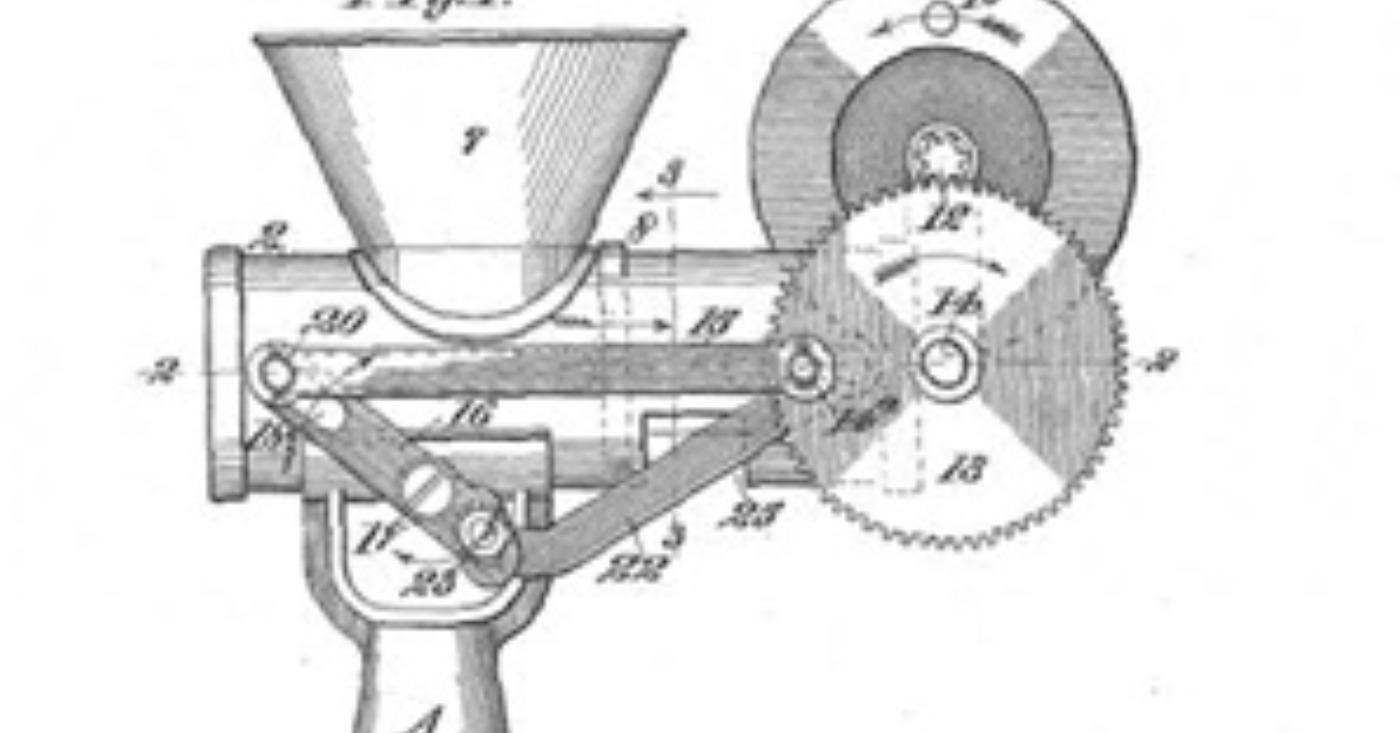
Turner’s machine was much more complicated than a simple handheld juicer. Fruit entered the machine through an opening at the top and was fed individually into a pressing chamber. Inside, a cutting mechanism divided the fruit. Two plungers then moved toward one another, using specially shaped concave and convex pressing surfaces to squeeze the fruit and extract its juice.
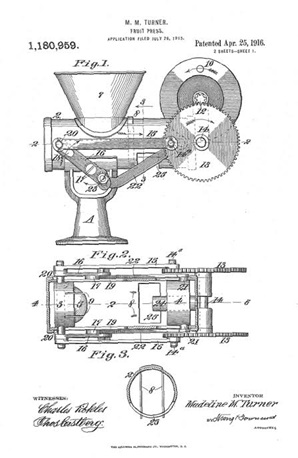
A copy of Madeline M. Turner’s juicer patent.

One particularly clever feature was the way the two plungers moved at different speeds and traveled different distances. Their coordinated movement allowed the machine to feed, cut, compress, and eventually release the fruit’s remains. She designed the apparatus to accomplish several steps mechanically rather than requiring a person to perform each operation by hand.

In her patent application, she also emphasized practicality. She explained that the machine was effective for its intended purpose and designed so that its parts could be kept clean—an especially important consideration for equipment used to prepare food and beverages.

Turner’s invention appeared during an era when the American food industry was rapidly becoming more mechanized. Machines were increasingly being developed to process, package, and distribute foods in larger quantities. Her fruit press demonstrated how mechanical engineering could make juice extraction faster and more efficient.

Unfortunately, historical records reveal little about what happened to Turner after her patent was issued. Her birth and death dates, education, family life, and later career have not been reliably documented. Even so, the surviving patent provides powerful evidence of her mechanical creativity and technical ability.

Today, Turner is remembered as one of the African American inventors whose innovations helped transform everyday life. Modern commercial juicing equipment is far more advanced than her 1916 machine, but the basic challenge Madeline tackled—automatically feeding, cutting, pressing, and extracting juice from fruit—remains central to food-processing technology.

Turner’s story reminds us that important inventors are sometimes nearly lost to history. However, thank goodness her patent will ensure that her creativity and contribution to American innovation will not be forgotten.

The post Madeline M. Turner: The Inventor Who Made Juicing Easier appeared first on BlackPressUSA.


Share. Facebook Twitter Pinterest LinkedIn Reddit WhatsApp Telegram Email
Previous ArticleGubernatorial Candidate Steve Hilton Blasts California New Tire Rules; Newsom Hits Back
Next Article Big City Mayors Ask for “Yes” Vote on Housing Bond Measure; Conservatives Say “No”
staff

Related Posts

Event Preview: ‘Fashion v. Fascism’ – A Runway Revolution Is Coming to the Bay Area

OP-ED: How Does Your State Rank for Pre-K?

Leaders to Gather at African American History Museum for Voting Rights Call to Action

Leave A Reply Cancel Reply

Video of the Week
https://www.youtube.com/watch?v=AxFXtgzTu4U
Advertisement
Video of the Week
https://www.youtube.com/watch?v=OjfvYnUXHuI
ABOUT US


The Windy City Word is a weekly newspaper that projects a positive image of the community it serves. It reflects life on the Greater West Side as seen by the people who live and work here.

OUR PICKS

Unleashing the Power of the Mach E GT: A Stylish and Sophisticated Electric SUV

Meet Kim Peavler, a Northwestern Medicine Central DuPage Hospital nurse making space for Black women with a mindfulness program that connects culture and presence

Headlines and Hot Topics

MOST POPULAR

BOOK REVIEW — Curved Air: A Biography of Sickle Cell Anemia and the Quest to Cure the First Molecular Disease

Prostate Cancer is Twice as Likely to Kill Black Men. Talking to Your Doctor Could Help Save Your Life

Prostate Cancer is Twice as Likely to Kill Black Men. Talking to Your Doctor Could Help Save Your Life

© 2026 The Windy City Word. Site Designed by No Regret Medai.
  • Home
  • Lifestyle
  • Podcast
  • Contact Us

Type above and press Enter to search. Press Esc to cancel.