



In his second inaugural address this month, Illinois Gov. J.B. Pritzker promised to “make preschool available to every family throughout the state” — a feat that will require solutions to staffing shortfalls, school capacity limitations and an increase to the state’s nearly $600 million early childhood education block grant program.
Providing free preschool “for everyone who wants it” will “require a multiyear approach to funding,” a Pritzker spokesperson said, adding that the governor’s administration will be “working closely … with legislators, advocates, and other stakeholders on this in the years to come.”
Advertisement
Pritzker’s office did not provide an estimated cost of expanding access to prekindergarten statewide, saying his budget proposal has yet to be finalized. Block grant dollars, which a spokesperson said would eventually fund the initiative, already fall short of demand, with 16 eligible full-day preschool programs denied grants due to a lack of funding in the current fiscal year, an Illinois State Board of Education report shows.
According to the most recent State of Preschool report from the National Institute for Early Education Research, Illinois enrolled less than a quarter of preschool-age children in 2021, when the state would have needed an estimated $505 million in additional funds to enroll all low-income children alone.
Advertisement
In Chicago Public Schools, Illinois’ largest school system, the governor’s universal pre-K commitment also implies the expansion of preschool to include 3-year-olds. This year, CPS fulfilled a 2018 promise to provide enough free, full-day pre-K seats for all 4-year-olds, a spokesperson said, with “limited half-day seats for 3-year-olds.”
With a statewide expansion on the horizon, lessons from the district’s implementation of universal preschool may prove useful, said Stacy Ehrlich Loewe, a senior research scientist with NORC at the University of Chicago, who has studied CPS pre-K enrollment over the last decade.
Rather than increasing the sheer number of options, “structuring programs in a way that meets families’ needs,” such as aligning with work schedules, may make a difference, Ehrlich Loewe said. When full-day preschool became more available, enrollment rose among previously underenrolled groups, particularly when programs were within a half-mile of families homes. That increased access provided a “pathway” to higher-average second-grade test scores, NORC’s research found.
But amid COVID-19, enrollment rates dipped nationally. “I think we’re still trying to find our way back from that. And without understanding what parents’ needs and wants are, it’s going to be very difficult,” Erlich Loewe said.

When universal preschool isn’t accessible, parents are left to navigate “a patchwork of options,” ranging from free Head Start programs for eligible low-income families to pricey private child care, said Terri Sabol, a Northwestern University professor who researches child development in schools and families.
“We know preschool is good for kids’ developmental gains and also good for parents’ ability to work,” Sabol said. “Being able to support that simultaneously … is really exciting policy.”
Though the practical realities entail a range of challenges, “the evidence we have is that you want to make sure that these systems are high-quality,” Sabol said. “You want to invest in teachers and teacher compensation, … professional development and building systems of care that are inclusive to the diverse learners.”
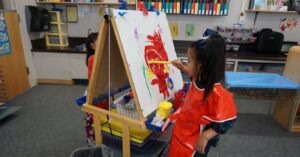
At School District 180 in west suburban Burr Ridge, Anne M. Jeans School fits 48 preschool students in three classrooms.
Advertisement
Principal Tracy Ritchey said the district typically does a couple of preschool screenings a year unless the slots are already full. The district determines which kids age 3 to 5 get in based on certain criteria and assessments.
Ritchey said if there were more paraprofessionals to partner with classroom teachers, more students could have preschool access, but the district is struggling to fill open positions. There’s also the question of where more pre-K students would be housed.
“If universal meant that the state was going to help pay for the preschool rooms, I could understand it, but I couldn’t accommodate any more kids than I have now,” Ritchey said. “Because preschool rooms are different than other rooms — the sinks, bathrooms and all sorts of stuff, and we only have three of those. If they said everybody could go to preschool and we’re going to pay for it, I would say I still don’t have space.”
In District 180, preschool hours are from 8:30 a.m. to 2:15 p.m., and children are given breakfast and time for rest. Though the district is fiscally sound and well-funded, Ritchey said the rules and regulations of operating a preschool-for-all system would still require a lot more staffing than the district has.

Advertisement
Some districts have relied on private-public partnerships to produce more space to teach toddlers.
“Public schools often don’t have enough space or appropriate space, so they need to partner with community providers,” said National Institute for Early Education Research policy specialist GG Weisenfeld. In New York, for example, she said some schools ensure the high quality of programs taught by community partners, who provide the necessary space.
A number of private early-learning providers in Chicago complained in 2021 that universal preschool was already “strangling” their operations, as parents began returning to office jobs after the height of the COVID-19 pandemic. But Beata Skorusa, head of school at the Montessori Foundations of Chicago in McKinley Park, advocates for collaboration. “I’d rather see us working as partners than competing for dollars and children.”
As for potential solutions to staffing shortages, Weisenfeld said states can create policies that spur workforce development by helping educators meet certification or licensing requirements. “We know that teachers with degrees and specialized training are really needed to … achieve a high-quality program.”
Outside of CPS, U-46 in Elgin is the largest school district in Illinois, offering free preschool to about 1,300 students each year who meet the state’s eligibility criteria.
Advertisement

U-46 has preschool programs in 10 buildings across the district that are funded by state grants, some half- and some full-day, said Katie Cox, director of U-46′s Early Learner Initiatives. Cox noted. At least 125 children are on a waitlist for spots for free pre-K.
“We know there is a great need for more learning opportunities before children enter kindergarten,” said Cox. “Our continued interest would be to increase the number of ISBE-funded slots and locally funded or tuition-based slots to meet the community need.”
U-46 also has about 150 preschoolers in special education preschool classrooms, funded by the district.
Within the district’s boundaries, there are an estimated 9,800 children ages 3 through 5, Cox said. About 35% of kids in the district live within the poverty levels that would qualify them for state-funded preschool, according to the 2018 Illinois Early Childhood Asset Map.
While Cox couldn’t comment on the governor’s plan and how it would affect U-46, it’s clear that one of the district’s long-term goals is to increase its preschool opportunities for families.
Advertisement

An upcoming referendum that will ask voters for approval to issue $179 million in school-building bonds could greatly help, she said, helping fund new preschool classrooms in some buildings and safety upgrades and renovations throughout the district, Cox said.
Following a push for a new school by parents in Chicago’s Belmont-Cragin community, Mayor Lori Lightfoot, CPS CEO Pedro Martinez and other officials recently gathered for a ribbon-cutting to mark the opening of Belmont-Cragin Elementary and Early Childhood Center.
According to city data, 43% of Belmont-Cragin children up to 4 years old were enrolled in preschool as of 2021, less than the city average of 47%. Spanish is the primary language for many school families, said Lightfoot, who committed a range of resources to improve equity in schools.
“We will be putting in the resources that are necessary to facilitate making that dual-language learning absolutely possible. … This facility will foster a well-rounded school experience for our students while answering the needs of this community,” she said.
The mayor, who is running for reelection, said there are “still too many schools in our city that face overcrowding or grapple with outdated facilities. And we are on the path to right that historic wrong.”
Belmont-Cragin is one of 369 CPS schools in 68 out of 77 Chicago community areas that offer free preschool programs for 4-year-olds, a district spokesperson said. CPS plans to add seats in the remaining nine Chicago communities — North Park, West Ridge, Edison Park, Beverly, Mount Greenwood, Dunning, Lakeview, Lincoln Park and Portage Park ― by Fall 2024.
Advertisement
As of Friday, 100 CPS preschool programs are full and may have a waitlist, according to the CPS early childhood enrollment portal. In total, more than 12,000 4-year-old preschoolers and nearly 4,000 3-year-olds were enrolled in the district as of the start of the school year. By state law, 37% of Illinois’ early childhood education block grant appropriation goes to CPS.
The district has also phased out tuition-based pre-K and all its programs are now free.
“The district took a phased approach … targeting the highest-need areas to initiate the expansion and the lowest-need community areas were the last to be served,” a spokesperson said. CPS didn’t provide information regarding future plans for programs serving 3-year-olds.
Along with the districts in Burr Ridge and Elgin, CPS is one of nearly 750 public school systems, out of over 850 statewide, which provide free or tuition-based preschool.
The Illinois State Board of Education provides early education block grants to a mix of community and school-based preschools.
Advertisement
While the details of Pritzker’s plans aren’t out yet, Weisenfeld, the researcher who studies preschool policy nationally, said she’s hopeful his plans for universal access will become a reality.
“One of the hardest things to really move the preschool agenda is political will. When you hear someone at the top, and the governor in particular, talk about it, it’s great news because he or she sets the priorities for the state,” Weisenfeld said.
“It’s not a bipartisan issue. … Prioritizing young children is a good thing.”


