




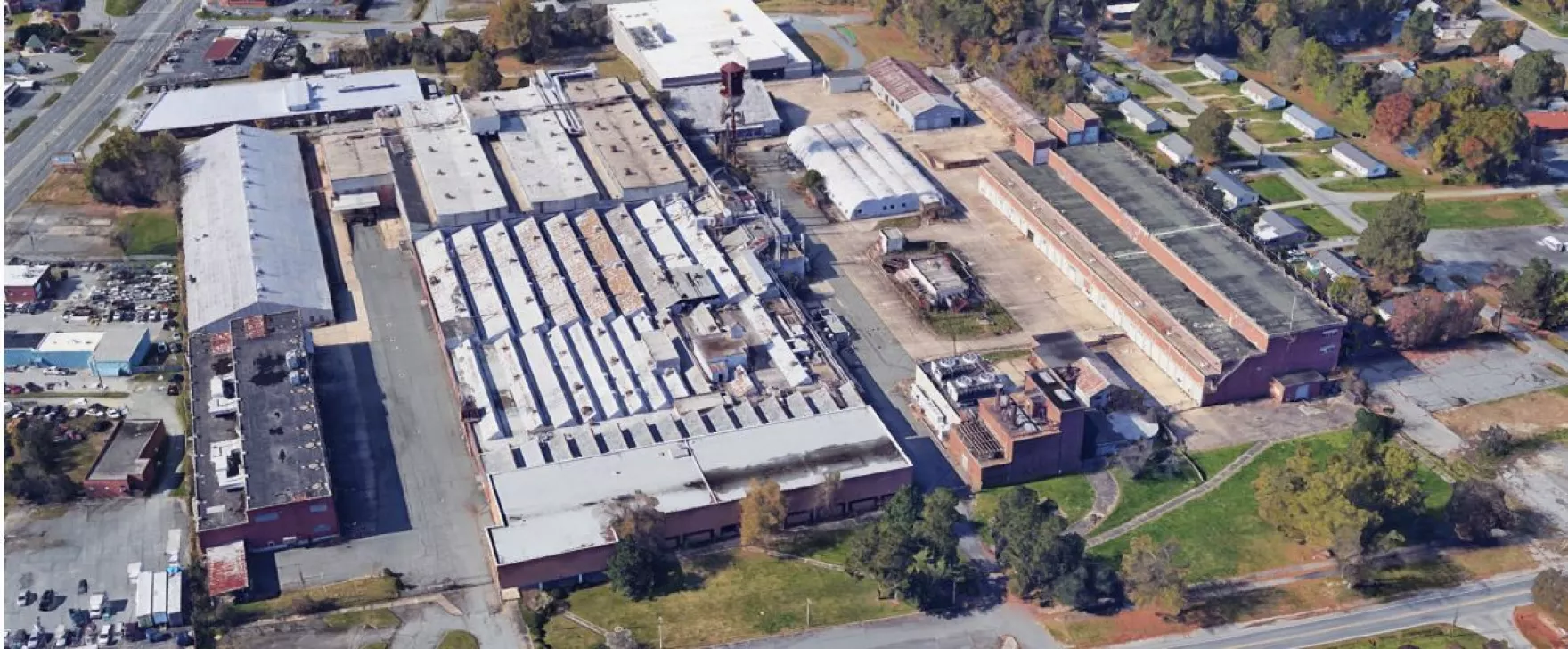
WUNC – Rows of low-lying brick buildings and corrugated tin bungalows crowd a 32-acre property in east Burlington. Photos from the 1990s reveal a silver water tower and pristine pipes glowing white in the sun. Now, these structures are rust-red.
This is the former Tarheel Army Missile Plant, or TAMP. A vestigial organ of Cold War-era military manufacturing, it has changed hands several times since the Department of Defense auctioned it off to a private buyer in the early 2000s. For the past three decades, the U.S. Army Environmental Command and the North Carolina Department of Environmental Quality (NCDEQ) have investigated and worked to address chemical contamination on the property.
This decades-long timeline may make their restoration endeavor look like a failure. But according to Sue Murphy, an NCDEQ engineer, in comparison to other projects, TAMP has been a resounding success.
“There are over 3,300 contaminated sites in this state of North Carolina, and a lot of them are way worse than this,” she said.
Murphy manages the NCDEQ’s restoration of sites – including TAMP – across the state. She says one explanation for the relative success of TAMP’s cleanup is culpability. There was a clear responsible party: Military operations caused the contamination, so the Army Environmental Command was sent to clean it up.
But for many other sites, culpability isn’t so obvious. In those cases, responsibility falls on the state.
In North Carolina, the Department of Environmental Quality’s Inactive Hazardous Sites program oversees more than 3,300 contaminated properties. But the state has limited money to investigate and clean them up. Murphy said the program’s budget had recently been doubled to $800,000 a year, an increase that still amounts to only a fraction of what the state would need to address the backlog.
“The budget for 3,300 sites has been doubled to $800,000 a year, which might cover sampling and assessment of one moderately contaminated site,” Murphy said.
The money available for that work comes from a federal program designed to support state oversight.
The Defense and State Memorandum of Agreement (DSMOA) program reimburses states for regulatory oversight on Department of Defense (DoD) properties. On Aug. 4, the Department of the Army abruptly suspended all reimbursement activities under the program, telling states to cease work covered by the agreement. Ten days later, on Aug. 14, the Army restored the funding. No explanation was provided for the suspension or its reversal.
For NCDEQ, the episode illustrated how quickly the resources available for environmental cleanup can change.
Army Environmental Command officials affiliated with TAMP said they were not aware of the funding changes, and the Department of the Army representative did not respond to requests for comment about the suspension.
The brief suspension did not eliminate the larger funding problem facing North Carolina’s contaminated-site program. But it exposed another vulnerability: Even work that has already been planned can depend on funding decisions that can be reversed with little notice.
The DSMOA program is intended to help states carry out regulatory work at military sites, including technical reviews, site visits, public participation and sampling. Nationally, states and territories receive more than $40 million annually through the program.
For North Carolina, that money supports oversight at Army-affiliated sites across the state, including locations where contamination has raised concerns about PFAS and other chemicals, such as Fort Bragg and Cherry Point. At these sites, contaminants have leached into groundwater, putting residents of nearby communities at risk.
Remediation work continues at Tarheel facility in Burlington
At TAMP, the Army has the resources and authority to investigate contamination because the federal government is the responsible party. When contamination comes from an uncertain or disputed source, determining who has to act comes before rehabilitation.
But even the federal agency (the Army Environmental Command) overseeing cleanup at TAMP has faced cuts from the last year’s larger reshuffling of federal funding.
“We’ve had a hiring freeze for about a year. And during this time, we’ve lost about 20 to 25 percent of the people that worked with us,” said Nathan Edwards, who leads the Southwest branch of the Army Environmental Command. Those cuts could affect remediation efforts.
The site’s Residential Advisory Board, or RAB, was created to ensure the surrounding community remains in the loop about TAMP’s restoration. They hold community meetings several times a year.
Despite this framework, there’s still a sense of wariness from the community members who attend these meetings. After decades of misinformation and failure to resolve the contamination on the part of the Army, many Burlington residents living in proximity to TAMP do not believe that the toxic waste has been cleaned up. Emily Sutton, who represents the Haw River Assembly as part of the RAB, mentioned during the July 29 meeting that despite safe TCE and PFAS values in tap water, many community members don’t dare drink it.
Based on reporting by The Carolinian.
The post Former Missile Plant Gets Toxic Cleanup While Thousands Wait appeared first on BlackPressUSA.