


By James Farr
What we knew. What we know? Now what?
- We knew the fire started beneath an Edison tower.
- We knew there was extreme fire weather. We knew families were dead, homes were gone, and Black Altadena had been scattered before anybody could tell them exactly why.
- For more than a year and a half, survivors lived inside that question.
Now we know.
- The investigation has named Southern California Edison. It has identified the tower. It has documented the electrical arcing. It has followed what fell from that tower to the vegetation below.
- Twelve seconds later, Altadena was burning.
- So the question is no longer, “What started the Eaton Fire?”
We know.
- Now what happens when knowing requires somebody—or somebody’s—to answer for it?
- That is where accountability begins.
- That is where this story moves forward.
If Wakanda were a real place, Altadena would be one of its communities.
A Black community that built something for itself. Homes. Families. Equity. Generations. In a region where redlining, restrictive covenants, and discriminatory lending practices told Black people where they could live—and where they could not—Black Altadena found a way to build anyway.
And then it burned.
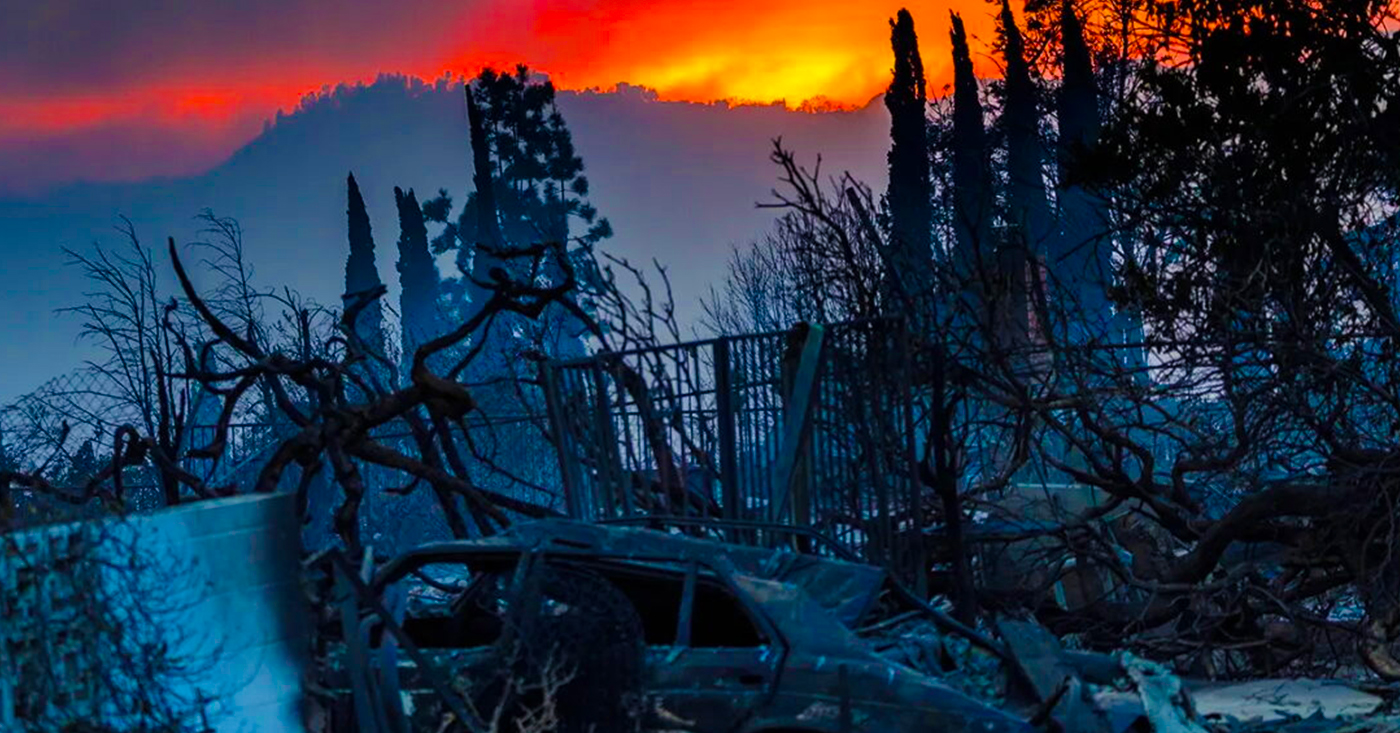
Nineteen people died. More than 9,400 structures were destroyed. But if you understand what Altadena was, you understand why counting what burned was never going to tell the whole story.
Because some of what burned had taken generations to build.
That is the part of this story that matters now.
For more than a year and a half, fire survivors lived with the question of what started the Eaton Fire while trying to figure out whether they could afford to come home to the community it destroyed.
Now we know. Southern California Edison.
The Los Angeles County Fire Department’s Fire Investigation Unit, working in conjunction with CAL FIRE, determined that electrical arcing from an out-of-service Edison transmission tower ignited the Eaton Fire on Jan. 7, 2025.
That finding answers one question. It started with Edison.
What happens to Black Altadena from here is the question that remains.
Edison had real-time weather information from its own monitoring systems, even as a National Weather Service red flag warning remained in effect for Los Angeles County. The winds that night blew at hurricane force—80 miles an hour—with no water to douse what any spark would become. The relevant transmission lines remained energized.
At approximately 6:11 p.m., a neighbor’s surveillance camera captured two bright blue and white electrical arc flashes mid-slope on the mountain above his home. Glowing material fell from the flashes toward the ground below. Investigators identified the location as Tower #1, the same tower another witness described seeing fire beneath from his backyard.
Two independent witnesses. Video evidence. Edison’s own meteorological data. All pointing to the same tower, the same moment, the same company.
The formal origin and cause investigation did not begin until January 9. Fire behavior and life-safety conditions on the night of Jan. 7 and the morning of January 8 made the scene inaccessible.
The Night the System Reached Its Limit
At 6:11 p.m., the fire started. Minutes later, the first 911 call came in. By 7:10 p.m., Los Angeles County Fire Department investigators had arrived at the burn perimeter—and found streets still on fire, residents still trapped and a system stretched past its capacity across two simultaneous catastrophic blazes.
LACFD investigator Casey Flanders arrived at the scene with a mandate to preserve evidence and determine cause.
Flanders pivoted.
An arson investigator—a man whose job is to read fire after it passes—spent that night pulling Black residents out of burning vehicles in West Altadena.
That is not a footnote. That is the architecture of what happened.
The county-commissioned after-action review would later document weaknesses in the emergency response, including outdated policies, inconsistent practices, and communication vulnerabilities. When the spark came, the emergency apparatus that existed to protect this community was already confronting simultaneous catastrophic fires.
Casey Flanders saved lives that night.
The system that required him to do it failed the people he saved.
Four days after the fire began, Pedro Pizarro, president and chief executive officer of Edison International, toured the origin site.
At that point, 18 deaths had been confirmed. The 19th victim had not yet been found.
No charges had been filed. The investigation was still open. Edison had not admitted responsibility.
Pizarro toured anyway.
What the Fire Took
Rodney Nickerson lived in his Altadena home for 57 years. He died in the fire. He was one of 19.
His daughter, Kimiko Nickerson, was born in that house. She gave her first live media interview on “Conversation Live: Altadena Forward,” describing a man who walked the Rose Bowl every morning, read the Los Angeles Times cover to cover every Sunday after church.
“He was a strong, intellectual, funny, vibrant, energetic man,” Kimiko Nickerson said. “He always had a good word for you, or a good article out of the newspaper, something that would get you through the day, or he had a Bible prayer for you.”
She now returns to the property with a lawn chair. She sits on what used to be the front of the house. She watches the crews work through neighboring lots.
She listens for birds.
“I’m gonna miss the birds and the woodpeckers,” she said. “There are a lot of trees they’re gonna take down that they’ve marked—trees I climbed as a child, grew up in as a child with my neighbors and my friends. And they won’t be there when I go back.”
She paused before she finished the thought.
“It’s just a moment that you didn’t even really know you were in until it was taken away from you.”
The Legal Clock Is Running
Attorney Carl Douglas has spent 45 years in courtrooms.
Douglas, managing partner of Douglas Hicks Law, represents Kimiko Nickerson. He also represents the family of Laura Swain, a woman he knew personally for 40 years who died in the fire.
“Never in my 45 years have I ever represented the family of someone who I knew when they were alive,” Douglas said on “Conversation Live: Altadena Forward.” “This ain’t just about business for me now. This is personal.”
The process, Douglas said, will take a minimum of three years.
For Altadena’s Black families – many uninsured or underinsured, many elderly, many holding generational wealth tied to land now covered in ash – three years is not procedural language.
Three years is the difference between holding on and being priced out permanently by developers already circling the burn zone.
The Los Angeles County District Attorney’s Office is reviewing the investigative report for possible criminal charges.
What comes of that review remains an open question.
Extraction Dressed as Recovery
Dr. Echele Williams, a licensed marriage and family therapist and Altadena community voice, named what she sees unfolding alongside the legal process.
“They’re offering extraction dressed up as recovery,” Williams said on “Conversation Live: Altadena Forward.” “What they’re not offering is restoration.”
Martin Gordon knows exactly what extraction looks like.
Gordon—an attorney and chairman of the Pasadena Community Coalition—escaped the fire with minutes to spare.
His wife was out of town, caring for her mother, when she called him. She had pulled up their Ring camera remotely and watched the fire closing in on their house.
She told him to get out.
He looked outside. He grabbed what he could and moved.
The fire took everything else.
His home. His writings. His archive. His artifacts. A Black Panther collection he had spent a lifetime building—gone.
Days later, Gordon stood in a church where the Altadena community had gathered in the immediate aftermath. He had no ID. No ATM card. He could not walk into a bank and prove who he was.
The fire had not just destroyed his property.
It had temporarily erased his identity and his ability to access his own money.
Daryl, a longtime Altadena property owner who asked that only his first name be used, sold his land in the aftermath.
He is one person.
He is also a pattern that community advocates watch with urgency, knowing that each parcel that transfers out of Black ownership narrows the path back for everyone who intends to return.
The Dome Holds
Kimiko Nickerson finds food trucks, neighbors checking on neighbors, and people she has known for 50 years showing up with presence and with hands.
“It seems like as soon as you go above Woodbury Boulevard, the love starts,” she said. “When you get up there, it is just breathtaking. I encourage people to go see the devastation and see the change as it comes.”
On “Conversation Live: Altadena Forward,” Farr offered a frame for what Nickerson described—Altadena as a Wakanda community.
“It has a dome over it right now,” she said.
The dome holds. Southern California Edison.
An out-of-service tower. Dry vegetation. A red flag day. Nineteen lives.
What the courts, regulators, prosecutors and the county do with that finding will help determine whether Altadena’s Black families rebuild on their own land or watch someone else build on it for them.
Forward
“All things are possible if you just push forward every day,” she said. “Change will come, but you have to work through the change – with God and a strong mind.”
Her father taught her that.
In the house she was born in. The house he read the Times in every Sunday. The house he came home to after the Rose Bowl, after church, after 57 years of mornings in Altadena.
The investigation has named who took that house.
Now Altadena watches to see who answers for it.

Edison Sparked the Fire That Destroyed Black Altadena by James Farr
This report draws from the official Eaton Fire Investigation Report, Case No. 25CALAC-009087, produced by the Los Angeles County Fire Department and filed by the multi-agency investigation team. Some portions of the public report carry redactions. This report draws only from what the verified public record confirms. Interviews with Kimiko Nickerson, Carl Douglas, Martin Gordon, Dr. Echele Williams and Daryl were conducted on “Conversation Live: Altadena Forward,” broadcast on KBLA Talk 1580.
The post Edison Sparked the Fire That Destroyed Black Altadena appeared first on BlackPressUSA.