



We have arrived at a terrifyingly familiar crossroads. Over the last year and a half, the current administration has executed its Project 2025 playbook to a tee, systematically dismantling the civil rights progress and hard-won gains of the past 60-plus years.
With every branch of the federal government aligned with this anti-Black program—and a majority of state governors and state supreme courts nodding in lockstep—the illusion of permanent legal protection has shattered.
The worst thing Blackfolk can do right now is assume that everything will “automagically” improve. History is screaming a different story. If we look closely at the repeating loops of the American experiment, we must ask an uncomfortable, urgent question: Is it past time for an exit strategy?
Historically, every single time Black people have fought, bled, and successfully forced this country to pivot away from its white supremacist foundations, a radical, violent political pushback has followed.
- The Reconstruction Precedent: After the abolition of slavery and the brief radiance of Reconstruction, the white backlash plunged Black America into Jim Crow—a violent rollback of rights that lasted roughly a century.
- The Modern Regression: The monumental gains of the Civil Rights and Black Power movements are being erased right in front of our eyes. In truth, the efforts to dismantle these wins didn’t start recently; they began while the ink on the Voting Rights Act was still wet.
Historians and social commentators today predict that it will take anywhere from 60 to 100 years for Black people living today to fully recover the legal protections, economic ground, and civil rights being stolen from us right now. That means the bitter, unvarnished truth is that most of us living today will not see better days in our lifetime.
If that’s true, why are we still organizing, marching, and voting with the exact same playbook and goals as before? We already know how that story ends: Anti-Black forces will always meet our appeals for justice with violent, economic, and political rollbacks. We need a new approach.
A 21st-century Underground Railroad
For months, national thought leader Lurie Daniel Favors has implored Black people and organizations to stop reacting defensively and start creating the framework for a “21st-century Underground Railroad.” This wouldn’t be a literal trail through the woods, but a sophisticated, underground network designed to allow Black people to escape systemic oppression, pool resources, and find genuine freedom.
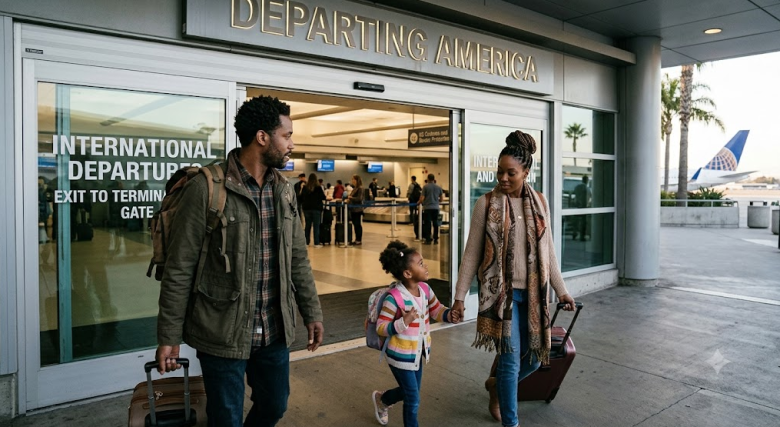
But what does a modern exit strategy even look like? The options generally split into two distinct paths: The physical exit and the systemic exit.
“If hereditary bondmen would be free, they must themselves strike the blow… use every means—moral, intellectual, and physical—that promises success,” said the illustrious and under-appreciated Black liberation theologian Henry Highland Garnet, in his Address to the Slaves of the United States, given during the National Negro Convention of 1843. Garnet called for open rebellion against slavery. His idea for an “exit strategy” failed by one vote of being endorsed by the convention.
Option 1: The expatriate route (physical exit)
For some, the answer lies in leaving the United States entirely. This is not a new impulse. In the late 19th and early 20th centuries, Black intellectuals and colonization societies led by figures like Alexander Crummell, Garnet, and Martin Delany argued that Black humanity, creativity, and intellect could never fully flourish on a soil so deeply poisoned by anti-Blackness.
Crummell actively championed emigration, believing that building up self-determining communities elsewhere was a far nobler use of Black genius than begging for citizenship from a nation that despised them.
In 2026, the expatriate route means looking toward West African countries (such as Ghana, with its continued “Year of Return” initiatives), parts of the Caribbean, or European hubs that offer a lower baseline of anti-Blackness. The goal is to relocate to societies that welcome our humanity rather than criminalize it.
But how many of us have the economic capacity to make such a move? On the flip side, how many of us can afford to stay in the U.S. with anti-Blackness rising exponentially daily?
Option 2: Economic secession (systemic exit)
For others, the best exit strategy isn’t physical relocation, but a deliberate exit from America’s economic and social systems. This means creating our own self-reliant, self-determining networks right here. It looks like building independent food supply chains, autonomous security apparatuses, private educational institutions, and closed-loop economic systems. It’s the practice of being in America without being dependent on it. Multiple Black Power Movement members back in the 1960s and 70s called that creating a “nation within a nation.”
The danger of assuming “It can’t happen here”
This is not a message of gloom and doom; it is an urgent wake-up call. Global history is littered with stories of “othered” groups whose rights were slowly, methodically eroded by the dominant society. In almost every instance—from pre-WWII Europe to various global genocides—the erosion of rights started slowly, and then accelerated so fast that it appeared to come out of nowhere.
In every single one of those historical tragedies, there was always a small, prophetic minority calling for an exit strategy. And in every instance, the vast majority of the oppressed group pushed back, insisting that conditions could never get that bad.
Until they did.
Activating the exit
We don’t need a singular, definitive answer today, but we absolutely must begin organizing around the possibilities. Blackfolk need to take concrete steps immediately:
- Assess and Resource: Black organizations and individuals must audit their assets, identifying who has the means, dual citizenships, or remote capabilities to pivot.
- Build the Infrastructure: We must fund the infrastructure for both paths—supporting those who choose to build autonomous zones of survival in the States, and establishing legal and financial pipelines for those who choose to leave.
- Normalize the Conversation: We must strip away the stigma of “giving up” on America. Leaving a burning house isn’t cowardice; it’s intelligence.
We can no longer afford the luxury of hope without a contingency plan. Whether we choose to exit geographically or economically, we must build the backdoor now. History has shown us the script—it’s time we finally change our ending.
Based on reporting by Jacksonville Free Press.
The post COMMENATARY: Blackfolk, Is It Past Time for an Exit Strategy? appeared first on BlackPressUSA.