



Author: staff


HBO would like to remind you — and Jerry West — that “Winning Time” is not a documentary.The network is sticking by its Showtime era Lakers show after team icon Jerry West lashed out about how he was portrayed in the series.Advertisement“HBO has a long history of producing compelling content drawn from actual facts and events that are fictionalized in part for dramatic purposes. ‘Winning Time’ is not a documentary and has not been presented as such,” the network told the Daily News in a statement Tuesday.“However, the series and its depictions are based on extensive factual research and reliable sourcing, and HBO stands resolutely behind our talented creators and cast who have brought a dramatization of this epic chapter in basketball history to the screen.”Advertisement[ Jerry West demands retraction of ‘deliberately false’ ‘Winning Time’ portrayal ]Last week, lawyers for West, who played for the Lakers before becoming the head coach and then general manager, demanded a retraction and public apology for his depiction “Winning Time: The Rise of the Lakers Dynasty,” calling it “a baseless and malicious assault” that “falsely and cruelly portrays Mr. West as an out-of-control, intoxicated rage-aholic” and “bears no resemblance to the real man.”[ L.A. Lakers HBO series ‘Winning Time’ a family affair for DeVaughn Nixon ]“The portrayal of NBA icon and L.A. Lakers legend Jerry West in ‘Winning Time’ is fiction pretending to be fact — a deliberately false characterization that has caused great distress to Jerry and his family,” his lawyer, Skip Miller, said in a letter sent to HBO and producer Adam McKay and obtained by the Daily News.“Contrary to the baseless portrayal in the HBO series, Jerry had nothing but love for and harmony with the Lakers organization, and in particular owner Dr. Jerry Buss, during an era in which he assembled one of the greatest teams in NBA history.”Magic Johnson, played by Quincy Isaiah, and Kareem Abdul-Jabbar, played by Solomon Hughes, have also criticized “Winning Time.”
The superintendent of Chicago’s 45th Ward has been charged with gun possession and official misconduct for attempting to sell a machine gun to an undercover ATF agent and a confidential informant while clocked in to his job with the city’s Department of Streets and Sanitation, authorities said.Ward boss Charles Sikanich was arrested Monday after being indicted on the charges last week, court records show. As he was being arrested, he “repeatedly asked to contact” 45th Ward Ald. Jim Gardiner before he was placed into custody, according to his arrest report.AdvertisementAssistant Attorney General Jonas Harger said in Cook County court Tuesday that the ATF got a tip from a confidential informant in February 2020 that Sikanich owned an MP 40 machine gun and was interested in selling it. Sikanich asked the informant to find him a buyer, Harger said.A meeting was scheduled with Sikanich, the informant and an undercover ATF agent, at which they all tried to negotiate a price for the illegal gun, authorities said. Time sheet records show he was on the clock at his Streets and Sanitation job during the time he allegedly was set to discuss the gun’s sale.AdvertisementSome months later, agents confronted Sikanich, who led them to a “secret compartment” in his basement where a black duffel bag containing the gun was recovered, Harger said.Sikanich’s attorney, Blaire Dalton, said in court the gun was a family heirloom, passed down from Sikanich’s grandfather. It dates from World War II’s Battle of the Bulge, Dalton said. The gun was “plugged” and unusable, she said in court, noting that the gun was seized in August but Sikanich was only charged this month.In response, Harger noted that it took the ATF less than an hour to render the gun usable, and it was still capable of firing shots. Sikanich “knew the gun was illegal and intended to sell it for an increased price because of illegality of the gun,” he said.Information about Sikanich’s bond was not immediately available.The charges are just the latest court proceedings for Sikanich. He and Gardiner are being sued in federal court by a man who claims Gardiner had him harassed, intimidated, and ultimately falsely arrested after he’d picked up a cellphone that Sikanich had inadvertently left at a 7-Eleven.Gardiner is also under federal criminal investigation involving his conduct in office, including whether he retaliated against constituents for political purposes, sources have told the Tribune.mcrepeau@chicagotribune.comjebyrne@chicagotribune.com

A 15-year-old student at the Latin School of Chicago was “tormented on a regular basis” by students at the prestigious school until he died by suicide in January, a lawsuit filed Monday alleges.The suit, filed by the boy’s parents, Robert and Rosellene Bronstein, accuses administrators at the school of “willful failure” to do anything about the bullying, even though they received numerous complaints from the boy and his family. The complaint, filed in Cook County, names the school, a number of employees and parents of the alleged bullies.AdvertisementLatin, a top-ranked school that charges more than $40,000 per year in tuition, includes former first lady Nancy Reagan, former U.S. Supreme Court Justice John Marshall Harlan II and other well-known public figures as alums.In a statement, the school called the claims unfounded. It said it “deeply grieves” the death of one of its students, but that it plans to “vigorously defend itself.”Advertisement“The allegations of wrongdoing by the school officials are inaccurate and misplaced,” the statement read. “The school’s faculty and staff are compassionate people who put students’ interests first, as they did in this instance.”The boy, identified as N.B. in the suit, transferred to Latin from Francis Parker School due to Latin’s in-person learning during the COVID-19 pandemic, according to the complaint.A student at the school, whose parents are named in the suit, spread a false rumor that the boy was unvaccinated, the suit alleges. Though he was vaccinated, the boy was harassed about his perceived vaccination status, the suit says. The Bronsteins reached out to the student’s family about the alleged harassment, according to the suit.The bullying escalated from there, according to the lawsuit. He was told by a teacher in front of a class that he was going “nowhere in life,” the suit alleges, and was cyberbullied in a group text message thread by members of the junior varsity basketball team and on the social media app Snapchat. A Snapchat message circulated around the school said of the boy: “Ur a terrible person.”On Dec. 13, a student sent a Snapchat message to the boy encouraging him to kill himself, the suit alleges.N.B. then met with a Latin administrator to report the bullying, the suit says, but the administrator did not discipline any of the students involved in the cyberbullying.Rosellene Bronstein had also been in communication with a school counselor about the bullying, the suit says. At one point, she told the counselor she believed her son might hurt himself and asked for a recommendation for a psychiatrist.Rosellene Bronstein notified school employees about the bullying numerous times, but the school dismissed her concerns as “family issues,” the suit says. In November and October alone, she contacted Latin more than 30 times.AdvertisementStudents walk through a bridge connecting buildings at Latin School of Chicago in 2020. (Antonio Perez / Chicago Tribune)Despite having anti-bullying policies and a stated “zero tolerance” policy for hate speech, school administrators turned a “blind eye” to the “increasingly desperate” pleas for help from the Bronstein family, according to the complaint.The boy also reported the bullying to a school dean about “monthslong abuse” but was disregarded, the complaint says.He died Jan. 13.The suit maintains that Latin violated a state law that requires all Illinois schools to investigate reports of bullying and notify parents of students involved. It also accuses the school of allowing a culture of bullying, as documented in an Instagram account that highlights alleged instances of bullying, harassment and hate speech. The suit says N.B.’s sister was also bullied at Latin.After N.B.’s death, Head of School Randall Dunn and some board members “conspired to withhold all of the above information from law enforcement authorities, from the full Latin Board, from other constituents of Latin and from N.B.’s family,” the suit alleges.The suit asks for an award of $100,000,000 on multiple counts of the suit. In a news release, the Bronsteins said they plan to share any money from the suit with anti-bullying organizations.AdvertisementThey said they demanded the school commit to an outside investigation, but Latin refused.“My son was so alone,” Rosellene Bronstein said in the release. “Not only were the administrators who were supposed to protect him ignoring his cries for help, but they had the self-serving gall to try to protect their own reputations after his death rather than just having the decency of being honest with his grieving family. This is a legal and moral failure that has caused us indescribable pain and agony.”For 24/7 help, call the free and confidential National Suicide Prevention Lifeline at 1-800-273-8255.mabuckley@chicagotribune.com
In just one week in April, the bodies of three women and a man were recovered from Chicago lake and river shores but the causes of their deaths remain unknown.AdvertisementThere are no suggestions of criminal activity, nor is it known if any of the deaths are connected, authorities have said. But why would so many appear around the same time?The situation may mirror that of 29 years ago. In early April 1993, the Tribune wrote that the bodies of two women had been found in the lake and a third in the Calumet River. The torso of an unidentified woman was also discovered.AdvertisementThat spring the Tribune reported that the annual thaw could be to blame. The bodies of those who drowned during the winter months could appear alongside more recent cases.“During the winter months, especially in areas where it’s really cold, decomposition gets delayed or stops especially if the water starts freezing,” said Dr. Ponni Arunkumar of the Cook County medical examiner’s office.“What happens when a person drowns is they sink down and as the bodies start decomposing, because all of us have bacteria in our intestines and bacteria in the water surrounding, during the decomposition process the gasses make the body lighter so they come to the surface and that’s when people see the bodies and report them.”Yuet Tsang, 80, was one of the women pulled from the Chicago River. The Near North Side woman was discovered April 16 off the 2800 block of South Eleanor Street near Bridgeport, according to the medical examiner’s office.Within an hour another woman, who has not been identified, was discovered at the 100 block of North Riverside Plaza in the West Loop Gate neighborhood, officials said. The next day, on April 17, the body of an unidentified man was discovered in Lake Michigan near the 3000 block of South Fort Dearborn Drive.A week later, a Back of the Yards woman later identified as 31-year-old Karina Alanis was found near the 2600 block of South Damen Avenue, officials said.Arunkumar said that decomposition can start at 60 degrees.“In the summer months, the process is much faster,” Arunkumar said. “People nearby will see these bodies quicker meaning someone who (drowns) may be seen within a few days.”AdvertisementIn 2020 and 2021, 60 to 70 drownings were reported, according to Arunkumar. That number includes all bodies of water but also indoor cases.tatturner@chicagotribune.com

Wednesday’s Chicago White Sox game against the Kanas City Royals at Guaranteed Rate Field has a new start time.Due to a forecast of cold temperatures, Wednesday’s game has been changed to 1:10 p.m. from the originally scheduled time of 6:10 p.m.AdvertisementAccording to a Sox news release, “game tickets, parking coupons and Huntington Bank Stadium Club passes for the 6:10 p.m. start will be honored for the 1:10 p.m. first pitch. Fans do not need to exchange any game tickets, parking coupons or Stadium Club passes to attend the rescheduled game.”[ [Don’t miss] Going to a Chicago White Sox game? Here’s what to know if you’re headed to Guaranteed Rate Field this season. ]The parking lots will open at 11:10 a.m. and the gates open at 12:10 p.m.Due to a forecast of cold temperatures, the start time for tomorrow’s game between the Chicago White Sox and Kansas City Royals has been changed to 1:10 p.m. CT from the originally scheduled time of 6:10 p.m. pic.twitter.com/WZ7GEUvxgd— Chicago White Sox (@whitesox) April 26, 2022
Wednesday’s Chicago White Sox game against the Kanas City Royals at Guaranteed Rate Field has a new start time.Due to a forecast of cold temperatures, Wednesday’s game has been changed to 1:10 p.m. from the originally scheduled time of 6:10 p.m.AdvertisementAccording to a Sox news release, “game tickets, parking coupons and Huntington Bank Stadium Club passes for the 6:10 p.m. start will be honored for the 1:10 p.m. first pitch. Fans do not need to exchange any game tickets, parking coupons or Stadium Club passes to attend the rescheduled game.”[ [Don’t miss] Going to a Chicago White Sox game? Here’s what to know if you’re headed to Guaranteed Rate Field this season. ]The parking lots will open at 11:10 a.m. and the gates open at 12:10 p.m.Due to a forecast of cold temperatures, the start time for tomorrow’s game between the Chicago White Sox and Kansas City Royals has been changed to 1:10 p.m. CT from the originally scheduled time of 6:10 p.m. pic.twitter.com/WZ7GEUvxgd— Chicago White Sox (@whitesox) April 26, 2022

Facing elimination in their first-round series with the Milwaukee Bucks, the Chicago Bulls were dealt another blow Tuesday when Zach LaVine entered health and safety protocols.LaVine will likely be out for Game 5 of the series, which tips off Wednesday night at 6:30 p.m. The Bulls will drive up to Milwaukee to prepare for Game 5 Tuesday night.AdvertisementWith Alex Caruso in concussion protocol, the Bulls might be down two starters for their must-win game.LaVine has averaged 19.3 points per game on 42.9% shooting in the first four games of the series. He is one of three Bulls players — alongside DeMar DeRozan and Nikola Vučević — to average double-digit scoring in the first four games of the Bucks series.AdvertisementThis is LaVine’s third round in the league’s health and safety protocols in the last year. He previously tested positive for COVID-19 last April, missing several weeks during the Bulls’ push for a play-in game. LaVine tested positive again last December during the league-wide outbreak following the omicron variant surge. LaVine said he was asymptomatic during both bouts of the virus.Bulls assistant coaches Chris Fleming and Damian Cotter missed Games 1 and 2 after testing positive for COVID the week before the series began. At that time, coach Billy Donovan said most of the Bulls players and coaching staff were not required to participate in a regular testing cadence.Donovan said the NBA allows individuals to wait 90 days after testing positive for COVID or receiving a booster shot to begin testing again. This policy doesn’t change after individuals on a team return positive tests and Donovan wasn’t required to test even after his assistant coaches tested positive.“We’re all concerned,” Donovan said. “You try to be as safe as you can as much as you can. I don’t know if it’s going back up again, but that’s certainly a challenge when that happens.”
Facing elimination in their first round series with the Milwaukee Bucks, the Chicago Bulls were dealt another blow Tuesday when Zach LaVine entered health and safety protocols.LaVine will likely be out for Game 5 of the series, which tips off Wednesday night at 6:30 p.m.AdvertisementWith Alex Caruso in concussion protocol, the Bulls might be down two starters for their must win game. LaVine averaged 19.3 points per game on 42.9 % shooting in the first four games of the series.More to come.
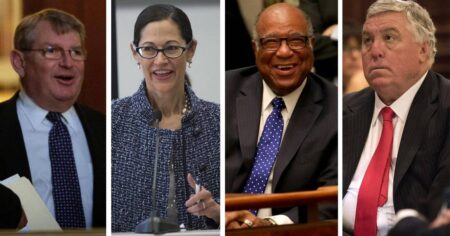
Prosecutors in the federal bribery case against a longtime confidant of former House Speaker Michael Madigan and three others told a judge Tuesday they have rejected having a bench trial, meaning the bombshell allegations will be heard by a jury in September.Attorneys for the four defendants had requested last month that the case be tried by U.S. District Judge Harry Leinenweber instead of a jury — a rarity in political corruption cases that would have required the approval of both prosecutors and the judge.AdvertisementDuring a statues hearing Tuesday, however, Assistant U.S. Attorney Amarjeet Bhachu said his office was rejecting the proposal, officially setting the case for a jury trial starting Sept. 12.The trial is expected to last about a month, with questionnaires mailed to prospective jurors a week ahead of time to help weed out any potential conflicts.AdvertisementCharged in the November 2020 indictment were Michael McClain, a former state legislator and lobbyist who was part of Madigan’s inner circle; Anne Pramaggiore, the former CEO of ComEd; John Hooker, a longtime ComEd lobbyist; and Jay Doherty, a consultant for the utility and one-time head of the City Club of Chicago.The 50-page indictment alleged that beginning in 2011, McClain and the other defendants “arranged for various associates” of Madigan — including his political allies and campaign workers — to “obtain jobs, contracts and monetary payments” from ComEd even in instances where they did little or no actual work.McClain and the other defendants also conspired to have ComEd hire a Madigan-favored law firm and lawyer, previously identified in public testimony as Victor Reyes of Reyes Kurson, and to accept into ComEd’s summer internship program a certain number of students who lived in Madigan’s 13th Ward, according to the charges.Pramaggiore and McClain also allegedly took steps to have Juan Ochoa, the former head of the Metropolitan Pier and Exposition Authority of Chicago, appointed to ComEd’s board of directors at the request of Madigan and McClain, the indictment stated.Madigan and McClain were indicted last month on separate racketeering charges that include the alleged ComEd scheme.At Tuesday’s status hearing, meanwhile, McClain’s attorney asked for an early deadline for both sides to file proposed jury instructions on the federal bribery statute, saying that their entire defense strategy will likely rest on what instructions Leinenweber will read before the jurors go back to deliberate the case.“We feel that this is such a crucial issue that it is appropriate to address it early,” said attorney Patrick Cotter, who represents McClain.Bhachu objected, arguing that the issue was not all that complex. But Leinenweber said he saw no reason not to do it early, ordering both sides to submit their proposals by May 16.AdvertisementIn pretrial motions, the defendants accused prosecutors of misusing the federal bribery statute, arguing that there was no quid pro quo agreement and that jobs, contracts and other payments to chosen Madigan political operatives constituted legal lobbying.But Leinenweber denied a motion to dismiss key counts of the indictment, writing in a ruling earlier this year that legal precedent dictated that the charges outlined were sufficient.jmeisner@chicagotribune.com
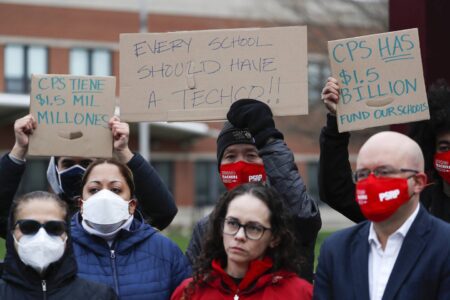
Emiliano Zapata Academy teachers and elected officials gathered Tuesday outside the Little Village elementary school to protest a proposed $894,000 cut to the school’s budget for the upcoming year.Last month Chicago Public Schools presented preliminary individual school budgets for the 2022-23 school year. If those figures hold, Zapata’s budget would be $5.9 million, down from $6.8 million this school year. On Tuesday school community members called on the district to spend federal COVID-19 funds to ensure no school would have to experience cuts, but especially those in Little Village, which was hit hard by the pandemic.Advertisement“We here at Zapata are projected to lose eight or nine teachers, which will most definitely dramatically increase class sizes. In my own classroom, I am projected to have 30 distinctly unique little human beings in front of me instead of the 20 that I have this year,” Zapata fourth grade bilingual teacher Jaquelina Salgado said. “There is no good reason why my future students should be crammed into a classroom where I will have great difficulty meeting their academic, their social, their emotional needs. They deserve so much more.”In a conversation with news reporters last month, CPS CEO Pedro Martinez said school enrollment was a major factor in the creation of the individual budgets. District enrollment declined from 340,000 students the last school year to 330,000 students this year. Zapata counted 554 students, down from 621, according to CPS data.AdvertisementPeople rally outside Zapata Academy in Chicago’s Little Village neighborhood on April 26, 2022, as they protest a proposed $894,000 cut to the school’s budget for the upcoming year. (Jose M. Osorio / Chicago Tribune)Martinez emphasized lower-enrollment schools and schools with the greatest needs would have enough resources for the fall, and more support from the central office would be provided to all schools.Local School Councils at CPS schools were directed to approve school budgets by April 19. It’s unclear if the figures the district released last month are the final numbers or if any schools were able to negotiate more money. CPS did not immediately provide comment.In all, about 200 of CPS’ 500-plus district-run schools were on track to receive less money, based on figures provided last month by CPS.Troy LaRaviere, president of the Chicago Principals and Administrators Association, said at last month’s Chicago Board of Education meeting that the raw numbers don’t tell the whole story.LaRaviere said they fail to account for a 5.5% to 6% increase in staffing costs when you factor in raises and “step” increases, which automatically boost an employee’s salary for adding a year of experience.“It is a fact that some schools receive roughly the same amounts they received last year. However, the CEO used that fact to imply these budgets would create stability. That was false,” LaRaviere said.“Handing (out) the same amount of money provides zero stability for students if that money doesn’t secure the same staff and services. If expenses go up and your budget remains the same, you create instability.”Outside Zapata on Tuesday, eighth grade civics teacher and parent Juan Sanchez was among those calling for the use of COVID-19 funding to stabilize school budgets.Advertisement“CPS has received over $2 billion in federal funds during the dawn of the pandemic, the majority of which has not made its way to our classrooms, and many of which remains unspent,” Sanchez said. “CPS has chosen — it’s a choice — to undercut, to underfund and to undermine schools like Zapata’s ability to adequately educate our children.”CPS is expected to receive $2.8 billion in direct emergency pandemic relief funding over five fiscal years. The district recently admitted it’s been slow to spend this money, but it also said it doesn’t want to create positions it can’t afford when the pandemic money runs out.Ald. Michael Rodriguez, 22nd, said he will work with teachers, parents and advocates to restore funding to Zapata and other Little Village schools. CPS is still formulating its overall budget plan for the next school year, which includes capital spending on construction projects. This year’s budget was $9.3 billion.A “Free the Funds” protest over proposed budget cuts is scheduled for 9:30 a.m. outside CPS headquarters in the Loop before Wednesday’s monthly board meeting.tswartz@tribpub.com