

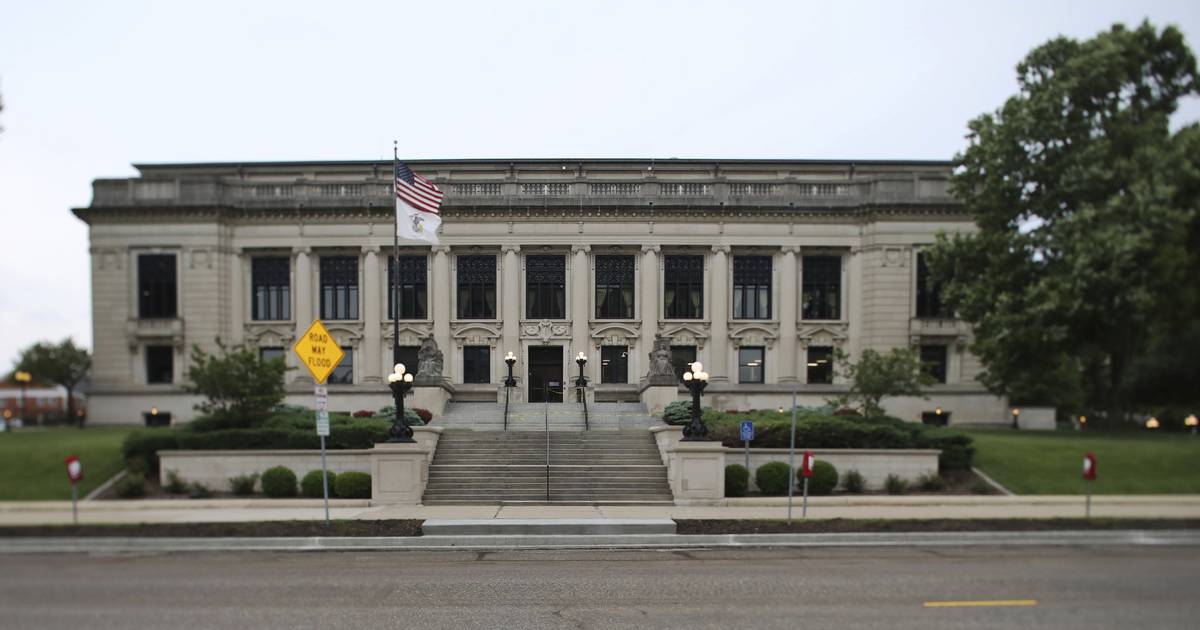
With less than a month to go before voters determine the balance of power on the Illinois Supreme Court, a federal judge has temporarily blocked provisions in two recent Democratic-backed state laws that limit contributions in judicial races.
The decision, handed down Friday, has the potential to unleash a deluge of cash into two hotly contested races for seats on the state’s highest court.
Advertisement
It stems from a federal lawsuit brought in August by a conservative legal group that argued the laws violate free-speech rights established in cases including the U.S. Supreme Court’s landmark Citizens United decision, which opened the door to unlimited political spending.
In issuing a preliminary injunction suspending the laws ahead of the Nov. 8 election, U.S. District Judge John Tharp Jr. found that the Chicago-based Liberty Justice Center and its clients, a former Illinois lawyer and two political action committees, have “some likelihood of success” in proving their case that the laws are unconstitutional and should be overturned.
Advertisement
Tharp also denied a motion to dismiss the lawsuit filed by Democratic Attorney General Kwame Raoul, who faces Republican Thomas DeVore for reelection next month.
The state laws in question were pushed by Democrats seeking to preserve their party’s control of all three branches of state government, including a 4-3 majority on the high court.
Democratic legislators last year approved a measure that bars judicial candidates from receiving campaign cash from out-of-state contributors and groups that don’t disclose their donors.
And this year, lawmakers approved a measure that bans contributions in excess of $500,000 per election cycle from a single source to independent expenditure committees set up to support or oppose judicial candidates.
Lawmakers who supported the measures argued that they were crucial to protecting the integrity of the courts in a state that has set records for campaign spending in races for the bench.
In non-judicial races, out-of-state contributions are permitted and independent expenditure committees can raise and spend unlimited sums, as long as they don’t coordinate directly with any campaign.
While there is some legal precedent for tighter restrictions on campaign fundraising in judicial races, the lawsuit argues that the two Illinois laws go beyond what courts have allowed in the name of preventing corruption.
The lawsuit specifically argues that John Matthew Chancey, a former Illinois attorney who retired to Texas, has a First Amendment right to support through financial contributions friends and acquaintances running for judicial offices in his former state.
Advertisement
Despite the state’s interest in maintaining the integrity of the courts, Tharp wrote, it “does not (and cannot) explain why money is more corrupting simply because its source is from outside the state.”
“Illinois’ exclusive targeting of out-of-state contributions raises a serious red flag that it is actually animated by what prospective out-of-state contributors have to say — or the ideologies of the judges whom they may tend to support — rather than public confidence in its Judiciary,” wrote Tharp, appointed to the federal bench in 2011 by President Barack Obama at the request of GOP U.S. Sen. Mark Kirk.
“Whatever its intent, the ban on out-of-state contributions will likely be more effective in preserving the status quo of the state’s judiciary than in enhancing its appearance of integrity,” Tharp wrote.
Likewise, Tharp didn’t give credence to the state’s arguments in support of the limit on contributions to independent expenditure committees, represented by two other plaintiffs in the case, Fair Courts America and Restoration PAC.
The lawsuit says Restoration PAC — founded by businessman Doug Traux, who ran unsuccessfully for the Republican U.S. Senate nomination in 2014 — wants to accept a contribution of more than $500,000 and to contribute more than $500,000 to Fair Courts America, both of which are prohibited by the new law.
Neither of the groups — which share a Downers Grove address and have the same committee treasurer, federal campaign finance records show — had reported any contributions as of Monday afternoon, according to state records.
Advertisement
After laying out some potential ways a donor could skirt the restrictions, Tharp wrote that the attorney general’s office “has not sufficiently explained how the $500,000 limit … accomplishes anything other than imposing some burden on plaintiffs’ exercise of their speech and associational rights.”
Jeff Schwab, senior attorney at the Liberty Justice Center, said in a statement Monday that Tharp “has correctly prevented Illinois from enforcing two laws by acknowledging that they likely violate American’s free speech rights protected by the United States Constitution.”
Raoul’s office is “reviewing the decision and evaluating our options,” spokeswoman Annie Thompson said.
The judge’s ruling applies only to the provisions on out-of-state contributions and donations to independent expenditure committees, not other portions of the laws.
Remaining in place is a $500,000 limit on contributions from individual donors in races where one candidate is self-funding or where there have been independent expenditures of more than $100,000 on behalf of one candidate.
Gov. J.B. Pritzker’s campaign fund already has made maximum contributions to the two Democratic candidates in races that will determine whether the party maintains its edge on the Supreme Court.
Advertisement
Democratic Lake County Associate Judge Elizabeth “Liz” Rochford faces Republican Mark Curran, a former Lake County sheriff, in the race for the Supreme Court seat in the new 2nd Judicial District, which includes Lake, McHenry, DeKalb, Kane and Kendall counties.
In the new 3rd Judicial District, comprising DuPage, Will and Kankakee counties, appointed Republican Justice Michael Burke faces Democratic Appellate Judge Mary Kay O’Brien.
Billionaire Ken Griffin gave $6.25 million to another independent expenditure committee, Citizens for Judicial Fairness, before the new law took effect in May.
Citizens for Judicial Fairness this month reported spending nearly $1.6 million supporting Curran and Burke and opposing the Democratic candidates.
Illinois has a history of record-setting spending on judicial races, highlighted by the successful 2020 campaign to unseat Democratic Supreme Court Justice Thomas Kilbride.
Together, Kilbride and the main group opposing his retention raised more than $11.7 million, the most expensive retention vote on record nationally.
Advertisement
Kilbride’s removal from the bench set off a chain of events that led the Democratic-controlled General Assembly to draw new boundaries for the state’s five judicial districts in an effort to preserve their party’s court majority. This is the first election under the new districts.


