



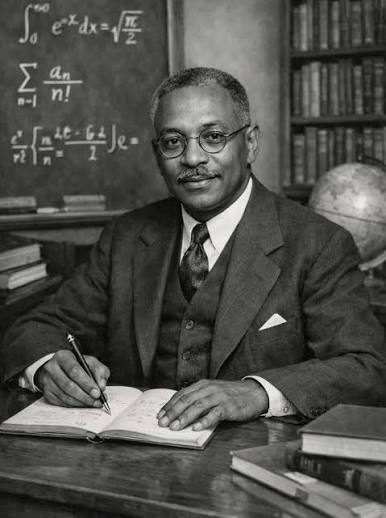
Elbert Frank Cox was born Dec. 5, 1895, in Evansville, Indiana, and attended segregated public schools that were chronically underfunded for Black students.
When Cox was six, a mob of white residents stormed the county jail after the murder of a white police officer, setting off a four-day riot that left as many as 13 people dead; it took a state militia of 300 men, called in by the governor, to end it, and roughly 2,000 of the city’s 8,000 Black residents fled in its aftermath. The Ku Klux Klan later established its Indiana headquarters in Evansville in 1920. Cox’s family stayed. Cox looked up to the Black teachers in his segregated schools, who pushed literacy and academic achievement despite having few resources to work with.
Cox enrolled at Indiana University Bloomington in 1913 to study physics and mathematics, one of just three Black students in his undergraduate class alongside his brother, Avalon. He took a wide range of coursework beyond his major, including German, English, Latin, history, hygiene, chemistry, education and philosophy, and earned A’s in every math course.
That achievement came despite treatment that made clear he was not considered an equal member of the student body: his transcript carried the word “colored” printed across the top, as did every Black students at the time, and in at least one class, Black students were made to sit in the hallway with the classroom door propped open so they could listen in rather than sit alongside their white classmates.
Cox was also passed over for membership in the Phi Beta Kappa honor society despite his academic record. Still, Cox found genuine mentors at Indiana among the math faculty: Cora Hennel, Schuyler Davisson, and Tobias Dantzig, all associated with the department’s Euclidean Circle. This student-and-faculty discussion group initiated Cox in 1915, making him its first African American member. He also served as secretary of the university’s Physics Club in his senior year and joined the historically Black fraternity Kappa Alpha Psi in 1915.
He graduated in 1917 with a bachelor’s degree in mathematics, listed at the end of his class’s yearbook entry alongside the three other Black graduates.
After graduating, Cox enlisted in the U.S. Army and served roughly nine months in Des Moines, Iowa, and France during World War I, from 1918 to 1919; he later told his sons he’d enjoyed his military service.
Returning home, he worked briefly as a high school math tutor before taking a teaching position in the segregated schools of Kentucky. And in the fall of 1919, he moved to Raleigh, North Carolina, to join the faculty at Shaw University as a professor of physics, chemistry, and biology, eventually becoming chairman of the university’s Department of Natural Sciences. He remained at Shaw for three years, until 1922, when he decided to pursue a doctorate and began applying to graduate programs.
Cox applied to Cornell University in December 1921, one of only seven American universities then offering a doctoral program in mathematics. His former Indiana professors wrote him letters of recommendation; Davisson wrote that Cox “surpasses any colored man I have known as a student in mathematics,” while Dantzig, in two separate letters, cautioned that Cox would likely encounter “certain difficulties… because of the fact that he is of the colored race” but predicted he would “develop into a man of whom the American mathematical world may be justly proud.”
Cornell’s own founding philosophy made it, in the words of one later retrospective, “a perfect fit” for Cox: founder Ezra Cornell had been an outspoken opponent of slavery who envisioned a university open to all who wished to be educated, and the school’s first president, Andrew Dickson White, had actively promoted the admission of women and people of color decades before Cox arrived.
Cox received the Erastus Brooks fellowship in mathematics, worth $400 a year, in the fall of 1924 and briefly followed Williams to McGill University in Montreal before returning to Cornell for the spring 1925 semester to finish his dissertation, “The Polynomial Solutions of the Difference Equation.”
He completed it that summer, and on Sept. 26, 1925, Cornell awarded him a Ph.D. in mathematics — making him the first Black person in the United States, and almost certainly the world, to earn a doctorate in the field. He was only the second Black Cornell graduate to earn any doctorate at the university, four years after Thomas Wyatt Turner became the first with a degree in biology.
Because doctoral degrees were still a relatively new institution in the United States, Williams urged Cox to submit his dissertation to universities abroad as a way of insulating his achievement from dispute, a fairly common practice at the time. Several institutions in England and Germany declined to consider the paper, almost certainly because of Cox’s race, before Tohoku Imperial University in Sendai, Japan, accepted it; the paper wasn’t formally published, in the Tohoku Mathematical Journal until 1934, nearly a decade later.
Within two decades of Cox’s graduation, roughly two dozen more African American students had gone on to earn Cornell doctorates, including seven in math or physics. Notably, Cox had also once been offered a scholarship to study violin at the Prague Conservatory of Music, but chose to pursue mathematics instead.
Cox began his teaching career as a Ph.D. holder at the all-Black West Virginia State College in 1925, just weeks after receiving his degree. In 1929, Cox joined the mathematics faculty at Howard University in Washington, D.C., where he would remain for close to four decades.
Cox was promoted to full professor in 1947, taught engineering science and war-management courses during World War II from 1942 to 1944, and became chair of Howard’s mathematics department in 1957, a post he held until 1961. He retired in 1965 at age 70, three years before his death; his portrait still hangs in the Howard mathematics department’s common room.
Over his lifetime, Cox published only two academic papers. He also became the first African American admitted into the American Mathematical Society. Those who knew him described a reserved, understated man — his son recalled that Cox “was not one to wear his achievements on his sleeve” and “didn’t do a whole lot of talking in general,” but that “when he did say something, it always made an impact.” Colleagues remembered him as conservative and patient, someone who always wore a tie to dinner.
Cox died in 1969 at age 73.
The National Association of Mathematicians established the annual Cox-Talbot Address in his honor, delivered at the organization’s national meetings, and Howard created the Elbert F. Cox Scholarship Fund to help Black students pursue graduate study in mathematics. In September 2025, on the 100th anniversary of his doctorate, Washington organized a two-day “Cox Centennial Celebration of 100 Years of Black Ph.D. Mathematicians” at Howard.
Based on reporting by The Carolinian.
The post Outnumbered: Elbert Cox’s Equation for Greatness appeared first on BlackPressUSA.