




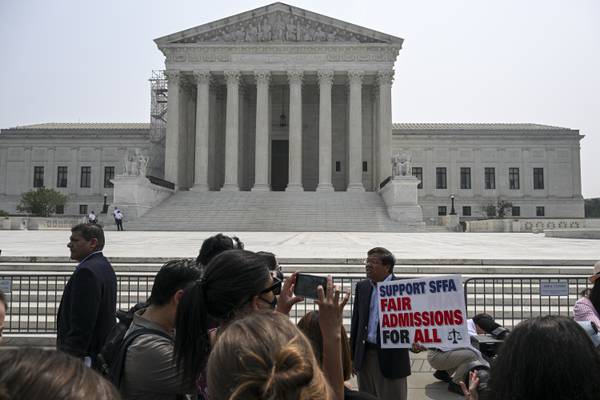
The U.S. Supreme Court ruled Thursday that affirmative action programs at Harvard and the University of North Carolina are unconstitutional, forcing universities and colleges nationwide to adjust admission policies.
In Illinois and Chicago, local officials were quick to condemn the decision.
“For centuries, students from historically underrepresented and underserved communities were locked out of higher education — preventing upward mobility and stunting economic development for generations to come,” Gov. J.B. Pritzker said in a statement. “This decision only sets us back.”
[ Supreme Court strikes down affirmative action in college admissions, says race cannot be a factor ]
Pritzker pledged to continue work expanding access to higher education for Illinois students of color, particularly through the state’s Monetary Award Program, which offers grants to full- and part-time students based on financial need.
Chicago Mayor Brandon Johnson, a former teacher and Chicago Teachers Union organizer, called the decision “devastating.”
“Affirmative action was a means by which generations of children were allowed access to institutions, access to ideas, and access to cultures that a wicked system of discrimination had long excluded them from,” Johnson said in a statement. “This decision will only further divide communities and strain existing inequities in higher education, but through those inequities will come opportunities for organizing and excellent in the face of struggle.”
The Illinois Board of Higher Education sharply rebuked the Supreme Court’s decision as well.
“The ruling is an attack on people of color, particularly Black people, who face discrimination through multiple facets of American society,” it said in a statement. “It is disheartening to know that there are people intent on stifling racial equity at a time when we should all be working together to break down barriers because that is the right thing to do.”
Eddie Phillips, provost and vice president of academic affairs for National Louis University, one of Chicago’s leading minority-serving universities, said the decision reverses decades of progress toward equity.
“I think it sends a clear message that students of color are not seen as important resources and assets to the academic community,” Phillips said Thursday. “This just sends a damaging message that this is not our country’s commitment, that students of color from some of these backgrounds will no longer have the same opportunities they want to enjoy under the previous protections of affirmative action.”
Phillips said the decision is another major victory for conservative activists, who have been pushing to end the systematic consideration of race in the college admissions process.
“This decision, unfortunately, isn’t surprising and is on par and consistent with some of the previous decisions that we’ve seen,” he said, citing the tumultuous 2022 ruling that overturned Roe v. Wade. “I think what it means for us as a nation is we are continuously moving away from closing equity gaps in addressing some of the systemic barriers that we know impact students of color, particularly those from marginalized backgrounds.”
Phillips said implementing the ruling would likely be tricky for institutions to navigate, particularly for schools with extremely competitive admissions processes.
“What has been clear is that race cannot be used as a plus-factor in admissions decisions and instead, other characteristics such as one’s socioeconomic status, or academic history could be used, potentially as a proxy for closing equity gaps, as opposed to using race as a proxy for closing equity gaps,” he said. “But in many cases, it’s hard to decouple those things.”
U.S. Sen. Dick Durbin (D-IL), the senate majority whip and chair of its judiciary committee, said the decision undermines progress toward racial justice in the United States. U.S. Sen. Tammy Duckworth, the second of three Asian American women to serve in the Senate and its first Thai American, called it a “devastating blow to progress, equity and equality for all.”
“Diversity always makes us stronger. Period,” she said on Twitter.
Illinois State Rep. Kambium Buckner, who unsuccessfully ran for mayor of Chicago earlier this year, said he wasn’t shocked by the conservative court’s opinion.
“We’ve got to make sure that we’re creating pipelines into these universities for young people who have been disenfranchised based on the lack of resources in their communities,” said Buckner, who attended and played football for the University of Illinois at Urbana-Champaign.
“No matter what this opinion says, I just want to double down on calling for the University of Illinois system and all of the public school systems in this state to take diversity and inclusion very, very seriously. Not just lip service,” he said. “We shouldn’t have to be governed by affirmative action laws to do this, right? Illinois is one of the most diverse states in the country. And all of our institutions should reflect (this).”
Illinois Attorney General Kwame Raoul was in a federal appellate court hearing on the state’s sweeping gun ban Thursday when the U.S. Supreme Court’s ruling was released. He had yet to read the decision, but said the high court has been chipping away at affirmative action for decades.
Raoul noted he was one of only a handful of Black students in his law school class and brought a different perspective to the classroom despite coming from a family that was “not without means.”
“I think that perspective is important to every higher education institution in the nation, not just from an African American, but from people of different races that get treated a certain way based on their race,” Raoul said.
Nationally, “It’s time to redouble our efforts,” former President Barack Obama said on Twitter. “Affirmative action was never a complete answer in the drive toward a more just society. But for generations of students who had been systematically excluded from most of America’s key institutions — it gave us the chance to show we more than deserved a seat at the table.”
Former first lady Michelle Obama, who grew up on Chicago’s South Side and attended Princeton and Harvard universities before she and her husband went on to work at the University of Chicago, shared her own experience as a young Black college student in a separate statement.
“I sometimes wondered if people thought I got there because of affirmative action … But the fact is this: I belonged,” she said. Special consideration for admission extends far beyond race-conscious admission policies, she noted, from affluent student athletes who receive private coaching to those who attend well-resourced schools with programs devoted to test prep and college entrance exams.
“We don’t usually question if those students belong. So often, we just accept that money, power, and privilege are perfectly justifiable forms of affirmative action, while kids growing up like I did are expected to compete when the ground is anything but level,” Michelle Obama said. “And while I know the strength and grit that lies inside kids who have always had to sweat a little more to climb the same ladders, I hope and I pray that the rest of us are willing to sweat a little, too.”
The court’s conservative majority overturned admissions plans at Harvard and the University of North Carolina, the nation’s oldest private and public colleges, respectively.
The vote was 6-3 in the North Carolina case and 6-2 in the Harvard case. Justice Ketanji Brown Jackson sat out the Harvard case because she had been a member of an advisory governing board there.
The Supreme Court had twice upheld race-conscious college admissions programs in the past 20 years, including as recently as 2016.
Chief Justice John Roberts said that for too long universities have “concluded, wrongly, that the touchstone of an individual’s identity is not challenges bested, skills built, or lessons learned but the color of their skin. Our constitutional history does not tolerate that choice.”
Justice Sonia Sotomayor wrote in dissent that the decision “rolls back decades of precedent and momentous progress.”
In a separate dissent, Jackson — the court’s first Black female justice — called the decision “truly a tragedy for us all.”
This is a developing story and will be updated.
Tribune reporters Jeremy Gorner and Dan Petrella, and The Associated Press contributed.