




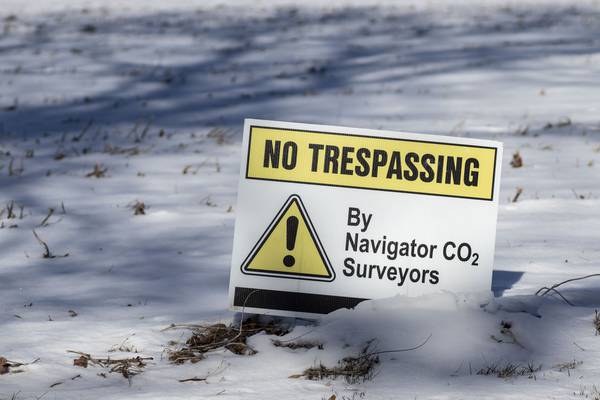
The company that wants to send part of a controversial 1,300-mile carbon dioxide pipeline through Illinois is seeking a fast-tracked permit from the U.S. Army Corps of Engineers that would not require public notification or input.
The expedited permit process, which is supposed to take about 60 days, can help businesses and regulators by reducing delays and paperwork.
But environmentalists — who discovered Omaha-based Navigator CO2′s pipeline permit application via a public records request — say that fast-tracking is intended for activities with minimal effects on waterways and wetlands, not massive interstate pipelines that carry a toxic substance and run under major rivers.
“They’re exploiting, essentially, a weakness or a loophole in the program,” said Lan Richart, co-director of the Champaign-based environmental group Eco-Justice Collaborative and a member of the Coalition to Stop CO2 Pipelines. “Our concern is that there is absolutely no opportunity for public comment.”
Navigator CO2 confirmed that it is applying for a fast-tracked permit, saying in an email that the pipeline clearly qualifies as “the impacts to (waterways and wetlands) resulting from construction and operation are well below the established thresholds of (the permit.)”
“Navigator has put significant effort into avoidance and minimization measures in its routing and installation methods to ensure minimal impact to natural resources,” the email said.
The Army Corps has not yet determined whether it will consider the Navigator pipeline under the expedited permit process, according to an email from the Corps.
Lan Richart and his wife, Pamela Richart, who is co-director of Eco-Justice Collaborative and lead organizer for the Coalition to Stop CO2 Pipelines, said in an interview that they want a full environmental assessment of the pipeline, of the kind that would be required for a major highway or railway. Because the pipeline is a private project, supported by federal tax incentives but not funded with federal grants, it won’t automatically face that kind of scrutiny, they said.
Carbon dioxide pipeline proposals are on the rise due in part to concerns about climate change, with the federal Inflation Reduction Act providing generous incentives to companies that can capture carbon dioxide from industrial plants and store it deep underground.
In the Midwest, proposed carbon pipelines would serve ethanol plants, which are considered well-suited to cost-effective carbon capture due to the very pure carbon dioxide emitted, as well as fertilizer plants and other industrial facilities.
There are currently about 5,000 miles of carbon dioxide pipeline in the United States, much of it in Texas, New Mexico, Louisiana, Mississippi and Wyoming. But that figure could increase rapidly, due to efforts to reduce greenhouse gases and prevent the worst effects of climate change. According to one study, the United States could have up to 69,000 miles of CO2 pipeline by 2050.
“This has some significant ramifications on a national level,” Lan Richart said of the Navigator CO2 permit application. “If you’re going to be doing this for the next 20 years — which we don’t want, but if that’s what happens — to do this all undercover, essentially, is not appropriate.”
Illinois farmers and environmentalists have been fighting the Navigator pipeline since 2021, citing concerns about safety, crop yields, and property values. Because Navigator wants to store millions of tons of carbon dioxide deep underground in central Illinois, there are also concerns about potential leaks and drinking water contamination.
Navigator has countered those arguments, saying that the pipelines, which run underground, will be “state of the art” and as safe as possible, that underground carbon storage has already been successfully achieved in Illinois, and that farmers will be compensated for potential crop loss. The company says that the pipeline would prevent up to 15 million metric tons of planet-warming greenhouse gases from entering the atmosphere each year — the equivalent of taking 3.2 million cars off the road.
The pipeline would run from South Dakota, Minnesota and Nebraska to Iowa, and then enter Illinois just north of the Iowa-Missouri border. The pipeline would continue north to Knox County, and southeast to Christian and Montgomery counties.
The plan is to inject the carbon dioxide into sandstone that lies deep underground in central Illinois. The state’s large deposits of naturally occurring sandstone — a good medium for holding carbon dioxide — make Illinois particularly attractive to carbon storage companies.
The rush to build carbon dioxide pipelines in Illinois includes not only Navigator but a 300-mile pipeline proposed by Wolf Carbon Solutions and Chicago-based Archer Daniels Midland Co. The pipeline would take carbon captured at ADM’s facilities in Clinton and Cedar Rapids, Iowa, and transport it to an existing underground storage site in Decatur.
[ Decatur plant at forefront of push to pipe carbon emissions underground, but costs raise questions ]
Another company, Summit Carbon Solutions, has proposed a carbon dioxide pipeline for Iowa, Nebraska, South Dakota, Minnesota and North Dakota, with underground storage in North Dakota.
Afternoon Briefing
Daily
Chicago Tribune editors’ top story picks, delivered to your inbox each afternoon.
The federal Inflation Reduction Act increased the financial incentives to build such pipelines, with tax credits of $17 to $85 per metric ton of carbon dioxide permanently stored underground.
For the Navigator project, which would have the capacity to store 15 million metric tons of carbon dioxide a year, that could mean $255 million to $1.3 billion a year in tax credits. The participating industrial plants would pay Navigator for carbon storage and receive the tax credits.
Lan Richart discovered that Navigator has filed for the expedited permit as a result of a Freedom of Information Act request, in which a citizen can obtain public records from the government.
The documents, which Richart shared with the Tribune, indicate that the pipeline would run under major rivers, including the Illinois and Mississippi.
Among the Richarts’ concerns: a pipeline rupture. That happened in Satartia, Mississippi, in 2020. A cloud of gas caused cars to stall out on the road, their engines starved of oxygen. People grew disoriented, foamed at the mouth and passed out. No one died, but 45 people sought medical attention at local hospitals, according to a government report.
“If there were to be a rupture under a river, what would that look like? That’s totally an unknown,” Pamela Richart said. “What would that do to aquatic life in the river?”