



While Chicago attracted most of the media attention for its mayoral race Tuesday, several prominent suburbs held hotly contested elections to choose new mayors.
Some races, as in Naperville and Oak Brook, consisted of candidates trying to succeed outgoing officeholders. Others, like Elgin and Joliet, attracted challengers trying to oust long-serving mayors. And one election, in normally staid Lake Forest, featured a controversial challenge to a long-standing caucus process.
Flashpoint issues ranged from assault weapons to lead water pipes to leaf blowers. While the contests typically are meant to be nonpartisan, they sometimes reflected divisions between conservatives and liberals in the suburbs.
[ 2023 Chicago live election results ]
In Naperville — the fourth-largest city in Illinois, with about 150,000 residents — incumbent Steve Chirico is stepping down after eight years as mayor. A recent poll showed the two leading candidates to replace him were in a virtual dead heat.
First-time office seeker Scott Wehrli is an executive at a family-owned concrete construction company and a part-time Park District police officer whose family settled in Naperville in 1840. Benny White is a City Council member, high school department head, former school board member and retired U.S. Army artillery officer, seeking to be the city’s first Black mayor.
A third candidate, Tiffany Stephens, who is also Black, founded Caring For Children Daycare and Kids Teen Rider, a nonprofit that provides transportation service to kids and teens.
Wehrli took in almost twice as much in campaign donations as White, much of it from real estate developers and brokers and Republican political action committees, while much of White’s money came from unions and Democratic state lawmakers.
White voted for the city’s ban on the sale of assault rifles, made in response to last year’s mass shooting in Highland Park, while Wehrli questioned whether it’s made anyone safer.
Joliet’s courting of the booming logistics industry and the repercussions of those developments on formerly rural areas south of town loom large among the myriad issues facing Illinois’ third-largest city as its residents vote to decide a hotly contested mayoral race.
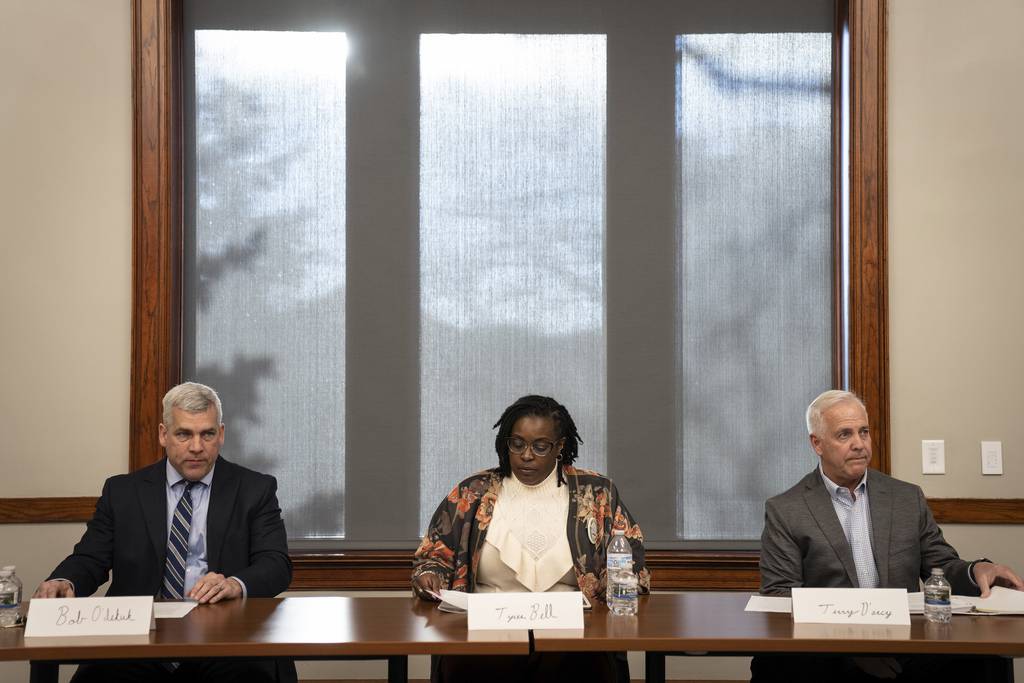
Two-term incumbent Bob O’Dekirk, an attorney and former Joliet police officer, faced challenges from community affairs professional Tycee Bell and Terry D’Arcy, a car dealer and well-known philanthropist.
O’Dekirk’s supporters praise the mayor for economic development projects that include a roughly $2 billion NorthPoint Development warehouse complex in south Joliet, a multimillion-dollar mixed-use development — anchored by the relocated Hollywood Casino Joliet — on the city’s West Side, and a possible redevelopment of the long-dormant U.S. Steel plant site north of downtown.
Still, the mayor’s critics accuse him of alienating neighboring communities with an often-overbearing leadership style that provokes political infighting that has marred his tenure as mayor. The city has had five city managers in as many years. The Police Department, meanwhile, is on its fourth chief since 2017 and is the target of an ongoing Illinois attorney general’s office civil probe.
O’Dekirk’s challengers pledged to repair Joliet’s tarnished image, to equitably invest in the city’s different neighborhoods and to work with surrounding communities to address concerns over future economic development in the region.
In Elgin, Mayor David Kaptain, seeking a fourth term, faced a challenge from City Council member Corey Dixon, an administrator in the Kane County sheriff’s office who manages programs addressing mental health and substance abuse among inmates.
In a recent forum, Dixon questioned Kaptain’s leadership on the need to replace the city’s lead water pipes, while Kaptain asked why Dixon was fined for repeatedly filing campaign disclosure forms late.
Dixon was seeking to become the city’s first Black mayor. While Kaptain boasted of a low crime rate and a flat property tax, Dixon emphasized plans for affordable housing and environmentally sustainable operations.
In west suburban Oak Brook, three village trustees were vying to replace Village President Gopal Lalmalani, who is stepping down after three terms. All three candidates made public safety their top priority after high-profile store thefts and a shootout that injured four people at Oakbrook Center mall in 2021.
Asif Yusuf is a four-term trustee and real estate broker who ran unsuccessfully for village president in 2007.
Dr. A. Suresh Reddy is a first-term trustee, a neuroradiologist and the president of the Indian American Medical Association.
First-term Trustee Lawrence “Larry” Herman is a tax accountant and CPA who owns an insurance agency. He received the endorsement of the outgoing village president.
In north suburban Lake Forest, a controversy interrupted the usually preordained nature of the election, as Mayor George Pandaleon steps down.
Typically, a volunteer Lake Forest Caucus committee recommends candidates for mayor and other offices. This election, the chosen mayoral candidate was former City Council member Stanford “Randy” Tack.
Former council member Prue Beidler objected that the caucus committee had nominated no women for the position or for three council seats, and a large group of residents turned out against the committee recommendations.
But the committee said the vote was nonbinding, and went ahead with its endorsement of Tack. That prompted Beidler to run as an independent. A third candidate, Paul Hamann, also ran as an independent.
Incumbent James Ford was seeking his third term as mayor. He was challenged by current City Council members Lisa Evans, 3rd Ward, and Ricardo Spivey, 4th Ward, as well as from Clifton Graham Jr., a former NAACP south suburban chapter president who owns a property management company with his wife.
Evans lost to Ford in 2015, when they were among five candidates seeking to replace a controversial longtime mayor, Dwight Welch.
Spivey is in his second term on the council, while Graham previously ran for state representative of the 38th District, which includes portions of about a dozen south suburban communities.
Harvey Mayor Christopher Clark faced a familiar opponent in his bid for a second term. Business owner and former park board President Anthony McCaskill lost to Clark in 2019 and to Clark’s predecessor, Eric Kellogg, in 2015.
Joining Clark and McCaskill in the mayoral race is first-term 2nd Ward Ald. Marshun Tolbert.
Public safety was at the forefront of the mayoral contest.
For the first time in its 22-year history, the village of Homer Glen was electing its first female mayor. Village Clerk Christina Neitzke-Troike and Trustee Rose Reynders were looking to replace Mayor George Yukich, who is unable to run again because of term limits.
Despite early tension in the race, Neitzke-Troike and Reynders espoused similar views on topics ranging from the need for political civility and land preservation to thoughtful economic expansion that maintains the village’s small-town feel.
Two attorneys — one a four-term Village Board member, the other a former educator involved in multiple civic groups — were vying to replace Mayor John Mahoney, who decided not to seek reelection to spend time with family.
Village Commissioner Nicole Milovich-Walters and Ronette McCarthy have said they both want to boost engagement with the village’s nearly 5,000 residents.
Two village trustees, Sonia Jenkins-Bell and Theo Brooks, looked to unseat incumbent Mayor Joseph Roudez III.
Access to clean drinking water continued to be a pressing issue for the village’s roughly 7,100 residents. Roudez said the village has sought grants to replace pipes, while his opponents want greater accountability from the village’s private water utility, Aqua Illinois.
Village finances were also a concern leading up to the election.
Suzanne Baker of the Naperville Sun; Alexandra Kukulka and Mike Nolan of the Daily Southtown; and freelance reporters Gloria Casas, Daniel I. Dorfman, Chuck Fieldman and Michelle Mullins contributed.