

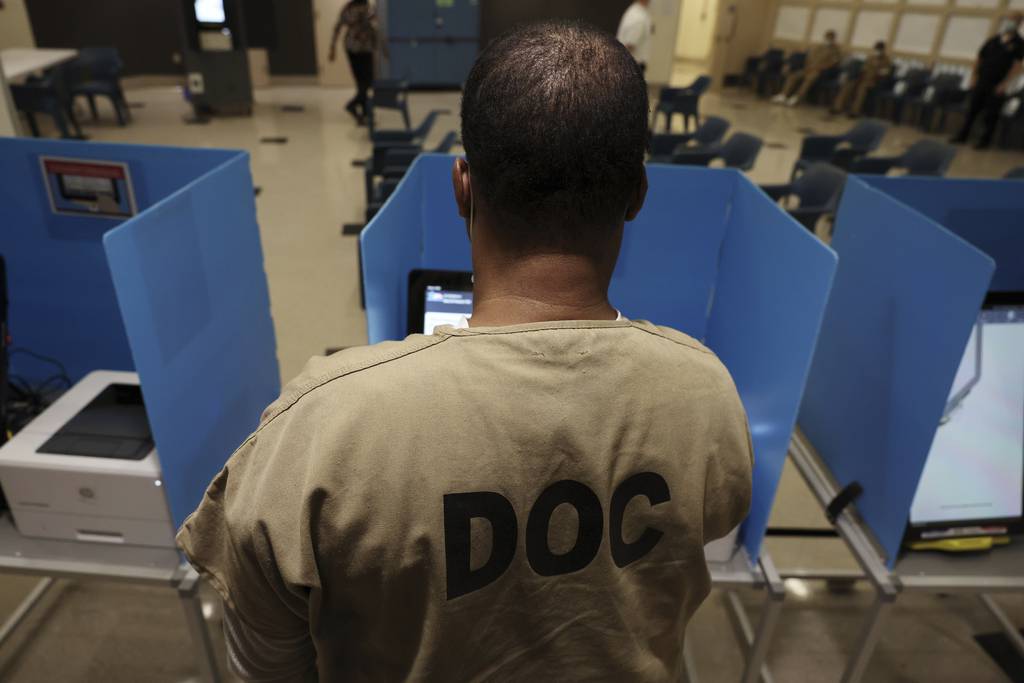
Chicago’s most active voting precinct has an unlikely cornerstone. A big chunk of its voters don’t cast ballots at an elementary school gym or a library — they vote from jail.
Voting at the Cook County Jail has risen sharply since the jail added pioneering in-person polling places in 2020. Incarcerated voters say they feel more heard as voting rights groups work to educate and register inmates, and politicians are taking note of the increasingly involved voters.
The sprawling facility at 2700 S. California in Little Village became the first jail in the country to operate as a precinct with in-person voting in March 2020, according to the Cook County sheriff’s office. Inmate voting soared following the addition.
In February, 1,553 incarcerated individuals voted in the city and county’s elections, up from 434 voters when inmates could only vote via absentee ballots during Chicago’s April 2019 runoff election, said Cook County sheriff’s office spokesman Matt Walberg.
Just over 50% of the jail’s registered voters cast ballots, Walberg added. That rate trounced the nearly 36% February turnout of registered voters citywide.
“It’s definitely evolved,” Cook County Jail Executive Director Jane Gubser said. “Where we are today, we’re very proud of it, giving more opportunities to people and getting them more involved.”
The inmates and voting advocates the Tribune spoke with said issues like safety, education and public transportation matter to the jail’s voters.
For several weekend days during election seasons, the jail, which houses around 5,500 inmates, operates multiple polling places throughout its many massive divisions set up in collaboration with election authorities. Any inmates who are not currently serving a sentence — which includes nearly all Cook County Jail inmates, the vast majority of whom have not yet faced trial and who are registered — can cast a ballot. Same-day registration is offered too.
Previously, ballots would be taken to inmates who would fill them out. The ballots would then be collected by jail staff and turned in to the mailroom.
But thanks to the jail’s burgeoning voting push, guards now escort inmates seeking to vote to a physical polling place, sometimes via the jail’s underground tunnels. They cast ballots inside blue voting booths, like so many other Chicagoans.
“It’s really important because people who are detained pretrial are left out of the equation,” Gubser said.
The jail director said she views voting as an essential way people affect policies and advocate for their rights. Anyone who wants to vote should be given the opportunity to, she said.
The efforts of advocacy groups to facilitate voting by educating and registering voters have made inmates casting ballots feel confident in their choices and proud of their participation, Gubser said.
Groups including Chicago Votes and Chicago Lawyers’ Committee for Civil Rights have worked to push voting rights inside the jail, Chicago Board of Election Commissioners spokesperson Max Bever said. He praised their work.
“Everyone who is eligible to vote should have access to the ballot box,” Bever said. In February, 629 inmates used same-day registration, he said.
Those efforts lit up an otherwise drab white-cinderblock room in the jail on a mid-March Tuesday morning as students from the University of Chicago Institute of Politics’ Bridge program worked to inform inmates on how to vote and what would be on the ballot.
The students passed out information sheets, including question and answer pages from the two mayoral candidates.
“A healthy democracy works when everyone who has the right to vote expresses that right,” undergraduate Estrella Hernandez told the two dozen inmates wearing the jail’s loose, khaki uniforms.
The students went over the history of voting and disenfranchisement. Most jail inmates have the right to vote, they explained.
People released from jail on parole or probation can cast ballots, they said. However, inmates currently serving a sentence in a federal or state prison, county jail or who are out on furlough cannot vote, they added.
“So, even if you’re on bail or bond, you’re subject to electronic monitoring, you are held in pretrial detention or you’ve been recently arrested but not convicted, you still retain your right to vote,” Hernandez said.
The inmates posed basic questions, the ones that hassle all voters and are only trickier to answer in jail.
“How would we know we’ve registered?” one asked.
An online tool allows people to see whether they are registered, Hernandez said, but prohibitions on inmates’ access to the internet might prevent them from using it.
Other inmates wanted to know where Paul Vallas and his mayoral runoff opponent, Cook County Commissioner Brandon Johnson, stood on different issues. They wanted to know the candidates’ positions on public transportation, what they thought about affordable health care, how they feel about the SAFE-T Act and who endorsed whom.
“Has he ever given out free gas or anything like that?” one inmate asked about Johnson and Vallas. Business owner Willie Wilson, known for his gas giveaways, comfortably won the jail’s precinct with 30% of the vote during the February election.
The students trod lightly as they responded to the political probes, avoiding preferences for either candidate in their answers..
“We’re not here to tell you who to vote for or what to vote about, but that you can do it and, if you are so inclined, that you should,” sociology masters student Lizzie Lewandowski said.
Percy Hicks studied the candidate handouts closely as the students spoke. After the information session, he said the voting discussion made him think about kids. Be it safety or schools, public policy always comes back to them, he said.
Hicks, 42, plans to vote in the mayoral runoff but declined to share for whom.
“I’ve got my people out there,” Hicks said. “I think my voice is going to be heard.”
He says the most important issue Chicago faces is crime. A greater focus on mental health would help, added Hicks, whose records show he is awaiting trial on drug charges.
Crime tops inmate Amjad Asaad’s concerns too. The father of a 16-year-old and a 17-year-old, Asaad said he voted in February and plans to vote again “to make it a better Chicago, a safer world for our kids to grow up in.”
He isn’t sure who he’ll vote for but liked hearing that Vallas, a former Chicago Public Schools CEO, has ties to police.
“That makes me feel safe,” Asaad said. “If there’s no safety, there is no future.”
Asaad, 39, appreciated the University of Chicago students coming in to share voting information. People taking the time to help him vote makes him feel like somebody, he added.
“You’re not even guilty until you’re actually proven guilty,” said Asaad, who faces vehicular hijacking and weapons charges. “There’s so many people who are incarcerated that need to be heard.”
And heard they are. Ald. Monique Scott, who is well-positioned to win a runoff for the 24th Ward City Council seat after being appointed to the position in June, said she is well aware that the jail precinct is the most active precinct in her ward.
While many jail inmates are registered at their homes and not the jail, many of the detainees use the jail’s address as the address for their voter registration. The 1,165 votes from the jail’s precinct, which also includes some land north of the jail, more than doubled the 24th Ward’s second-highest precinct vote total.
Scott said many inmates may vote because it gives them something to do. But the detainees also have important concerns about the community, she added.
“They’re constituents. They all have a right to vote,” Scott said. “Every person should have a right to vote … Everybody should be treated human.”
Scott says she can do little to affect jail policy because the jail is run by the county, not the city. Still, she reached out to acquaintances who work at the jail to learn more about the issues inmates face. As a result, she plans to advocate for better food at the jail, she said.
While it’s hard to do much as an alderwoman for people who are “property of the Cook County Jail,” Scott can serve them by addressing the issues they and people outside the jail care about, like cleanliness and road quality, she said.
Scott said she was bothered that turnout in many precincts was smashed by people “who don’t even have freedom.” But inmates voting doesn’t trouble her, she said.
Afternoon Briefing
Daily
Chicago Tribune editors’ top story picks, delivered to your inbox each afternoon.
After the voting information session, Hannah Kaplan, a University of Chicago public policy masters student who also volunteered, called it “crazy” that the Cook County Jail became the first in the country to work as an in-person voting precinct in 2020.
“To say that people in jail have the right to vote but then not have a polling place in a jail is still effectively taking away the right to vote,” she said.
Voting is linked with lower rates of recidivism, fellow student Lewandowski added.
“People aren’t in jail forever,” she said. “People get out. People come home. And people should still be able to engage with the things that are going to shape their community.”
Some inmates stop Hernandez after the information sessions and tell her they didn’t know they could vote before, she shared. For the students, the jail visits “break through anything you read on a page.”
“When people have access to this tool, they do want to vote,” Hernandez said.