


Browsing: Sports
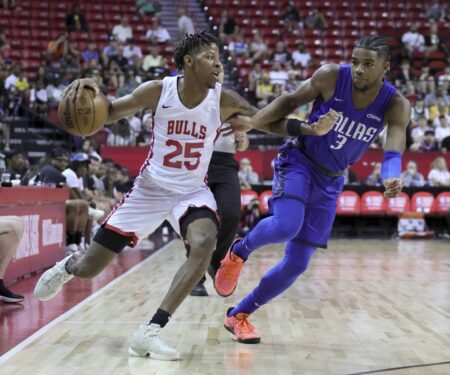
The Chicago Bulls showed the first glimpses of next season’s roster during the NBA Summer League in Las Vegas
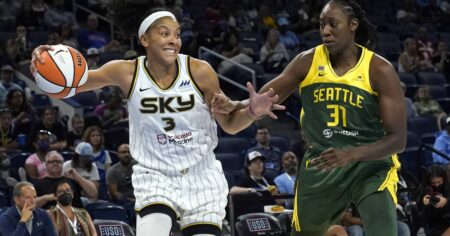
Allie Quigley scored 18 points, Emma Meesseman had 16 points, 10 rebounds and six assists and the Chicago Sky
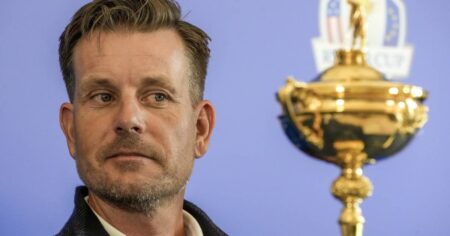
Henrik Stenson was removed as Ryder Cup captain for Europe, choosing guaranteed money offered by a Saudi-funded rival league
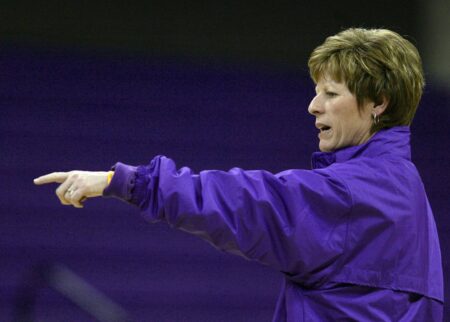
As part of the Tribune’s coverage of the 50th anniversary of Title IX, we asked for ideas of women who made an impact on Chicago-area sports history.In June, the Tribune published profiles of 50 women throughout sports and 20 women in sports media who were notable for their accomplishments on and off the field. But we wanted to hear from readers about who they thought deserved attention for their work in girls and women’s sports.AdvertisementHere are some of their ideas.In narrowing the scope of the project to the Chicago area — aside from a few exceptional Illinois athletes — we cut out some notable women from universities in the region, including Notre Dame basketball coach Muffet McGraw, Illinois State basketball coach Jill Hutchison and several key University of Illinois administrators.But one we perhaps should have included — especially given her roots at Rich East High School and the scope of her impact — was former Northern Illinois athletic director Cary Groth. She played basketball and tennis at NIU, coached women’s tennis there and was an administrator before rising to become athletic director in 1994, one of three female ADs at an institution with NCAA Division I-A football at the time.AdvertisementGroth was NIU’s AD for 10 years before becoming athletic director at Nevada, and she recently was elected to the Mid-American Conference Hall of Fame. She’s on the faculty at Nevada’s College of Business and founded The Pictor Group, a college sports consulting firm.Other suggestions from universities outside the Chicago area included Pat McKinzie-Lechault, a Sterling, Ill., native who earned Illinois State’s first women’s basketball scholarship in 1978. She went on to play professionally in the short-lived Women’s Professional Basketball League and in Europe and is an author who has written about Title IX.Rockford’s Deb Patterson, who went to Rockford College, was the Kansas State women’s basketball coach from 1996-2014. Her teams made nine NCAA Tournaments and she twice was named the Big 12 coach of the year. She’s now the director of player personnel and program analytics at Washington State.Kansas State coach Deb Patterson calls to her team during practice on March 18, 2005, before an NCAA Tournament game in Seattle. (TED S. WARREN / Associated Press)Mary Terwilliger was a track athlete who went to NIU in the 1930s. She was an AAU star sprinter and made two Olympic Trials. She was a peer of Chicago sprinter Tidye Pickett, whose compelling story the Tribune told in 2016.Sandra Bucha was among the early fighters for girls opportunities in Illinois high school sports.A talented swimmer, Bucha trained with the boys team under Hinsdale Central coach Don Watson but wanted to compete with them in meets. In the months before Title IX was signed into law, she filed a lawsuit against the Illinois High School Association to push for girls to be allowed to compete with boys in non-contact sports. The suit was unsuccessful, but the IHSA’s implementation of girls swimming was not far behind.Bucha went on to become an accomplished marathon swimmer who was inducted into the International Swimming Hall of Fame.Only a few of the hundreds of worthy Illinois high school coaches received recognition in our profiles, but longtime Chicago-area sportswriter Jack McCarthy believes former Mother McAuley volleyball coach Nancy Pedersen merited mention.Pedersen retired in 2004 with nine state titles and a career record of 789-110.Mother McAuley volleyball coach Nancy Pedersen smiles after beating Lyons in her last home game on Oct. 20, 2004. (Abel Uribe / Chicago Tribune)Women who worked in sports business or charities were not a big part of our profiles, unless they worked for one of the Chicago professional teams, like the Blackhawks’ Jaime Faulkner and the Bears’ Karen Murphy.So there’s probably many we could add, but two suggestions were Lisa (Meyers) Strasman and Barb Lazarus.Strasman grew up playing hockey in Skokie and went on to play at Yale and internationally. She now is the president and COO of Next College Student Athlete (NCSA), a Chicago-based recruiting organization that connects high school athletes with college coaches.Lazarus is the founder of Game On! Sports 4 Girls, which helps promote healthy lifestyles for girls through sports and fitness via summer camps and school-year programs.A couple of readers wrote to share their experiences of fighting for their place in sports, including former Morton West student Barbara Lukes Collins.Collins said she covered a boys indoor track meet for her high school newspaper in 1965. She had to fight to have the article included on the sports page, and her adviser was going to publish it without her byline because she was a girl.AdvertisementAfter she insisted on a byline, it was published under the name B. Lukes. Collins was irritated her first name was omitted but still takes pride in the fact she was the first girl to cover a sports event for the paper. She went on to study journalism and has written two books on horticulture.Here’s to all of these women who fought for their places in sports — and the millions more.
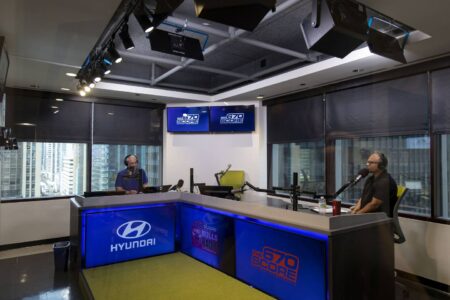
Seven minutes.That’s how long it took for Laurence Holmes to take a playful jab at Dan Bernstein during the premiere of the “Bernstein and Holmes Show” on WSCR-AM 670.AdvertisementThe Score hosts were discussing parking and transportation issues downtown when Bernstein took a right turn.“And you hear what’s going on in Rome?” Bernstein asked. “People are getting pancaked right and left. Ooh, there’s a Fiat! Oops, I’m dead. And if you’ve ever walked around Rome, it is hard enough to not die.”AdvertisementHolmes pounced.“Not all of us can relate to walking around Rome,” he said.Countered Bernstein: “Walking around those streets, it is like a leap of faith, man. You just walk and you hope the cars stop. They ain’t stoppin’ for you.”Holmes then polled Adam Studzinski and Rey Diaz, who along with Mike Rankin produced the show that day.Dan Bernstein and Laurence Holmes broadcast during the “Bernstein and Holmes Show” on June 30, 2022, from the WSCR-AM 670 studios. (Brian Cassella / Chicago Tribune)“Studs, Rey, pay attention: How many of you, show of hands, have walked around Rome?” Holmes asked. “I don’t see Rey with his hand up, I don’t see Studs with his hand up and I don’t have my hand up. Therefore …”“Therefore you can all go screw yourselves and consider yourselves warned,” Bernstein said.“Mr. Relatable, Dan Bernstein!” Holmes chanted.“That didn’t take long,” Bernstein said with a chuckle before running through the show itinerary.AdvertisementSo began the on-air marriage of Bernstein and Holmes, two Score veterans who have succeeded solo and with partners, survived the industry’s cutthroat cutbacks and thrived in the competitive world of Chicago sports-talk radio.The show, which debuted June 20, will be a month old Wednesday when the station celebrates its 30th birthday with a 6 a.m.-6 p.m. open house for listeners to visit with Score hosts and contributors past and present during a live broadcast at Real Time Sports in Elk Grove Village.And in the Score’s 30-year history, perhaps no duo has had the swagger that Holmes and Bernstein bring to the station’s new midday show.Shortly after Score operations director Mitch Rosen announced the Bernstein-Holmes partnership in a June 16 news release, the station began airing promotions, labeling it a “powerhouse” pairing.And in the world of sports-talk radio, it is.Holmes was 22 when the Score hired him in May 1998 as a part-time producer. Five years later he took over covering the Chicago Bears for the station and eventually became a host.AdvertisementBernstein started working at the Score in May 1995 as a Bears reporter before getting his own weeknight show in May 1999. Three months later he teamed with Terry Boers, a pairing that lasted more than 17 years until Boers’ retirement in December 2016.Laurence Holmes broadcasts alongside Dan Bernstein during the “Bernstein and Holmes Show” on June 30, 2022, from the WSCR-AM 670 studios. (Brian Cassella / Chicago Tribune)Dan Bernstein broadcasts alongside Laurence Holmes during the “Bernstein and Holmes Show” on June 30, 2022, from the WSCR-AM 670 studios. (Brian Cassella / Chicago Tribune)That’s a combined 51-plus years at the station.Holmes spent the last 13 years as a solo act, hosting a weeknight show from 6-10 p.m. for nine years and from noon to 2 p.m. the last four. He hadn’t had a co-host since Bears Hall of Famer Dan Hampton in 2009.And while Holmes, 47, and Bernstein, 53, had plenty of interaction during show transitions and fill-in appearances over the years, sharing mic time for four hours daily would be a new challenge — which is exactly what Holmes wanted.“I think Dan’s really smart,” Holmes said in an interview before their first show. “So when you’re used to, like I am, doing a solo show, I hope that my scope is not limited, but it still is usually from my perspective, and I think Dan is really good at offering up a different perspective and saying, ‘Well, have you thought about it like this?’ or ‘This is the way that I’m seeing it.’ That’s the way I think we can challenge each other and vice versa.Advertisement“I know where a lot of (the perspectives) mesh. I don’t know where a lot of them come to a head, and that’s the fun part of doing a show every day with a partner — figuring out where those things are.”Bernstein concurred.“That is an important aspect of every show with more than one host,” he said. “Both of us are experienced and confident and look forward to that open exchange of thoughts and ideas.“The concept of being challenged every time you turn the mic on is fundamental to what we do. Even if it’s a solo show. Even if it’s a producer jumping on with a thought or dealing with callers or guests. If someone doesn’t feel properly challenged, you’re not getting the joy and invigoration that this medium can bring.”The “Bernstein and Holmes Show” wouldn’t have been a show without Leila Rahimi taking over as the lead sports anchor at NBC-5 in April. She had been co-hosting with Bernstein at the Score since January 2021.Bernstein kept the 9 a.m.-noon slot after Rahimi left until Rosen approached Holmes with the idea of doing a show with Bernstein for one afternoon, and Holmes was game. “It was really a lot of fun,” Holmes said.AdvertisementA few weeks later, Rosen asked Holmes if he would consider partnering with Bernstein long term.“And I said, ‘Yeah, that would definitely be something I’d be interested in,’ ” Holmes said.Bernstein didn’t need any convincing.“The first thing I said was, ‘That show’s going to be great,’” Bernstein said. “It’s in large part due to Laurence’s ideal combination of a reporter’s mentality with an entertainer’s sensibility. He — and I think this is really important for what we do at the Score that may be different than a typical sports radio station — is understanding there’s a time and a place to have fun and have it be fun, and there’s a time and a place for it to be serious. And understanding those differences on those days is critical. Big, important stories are going to get the biggest, most important, most significant serious coverage.“But it’s ultimately entertainment, and he and I share — we’re of similar age, so I think we have some similar cultural touchstones in our lives. And he’s extremely well-read, he is a well-rounded intellect above and beyond sports, which I think is so critical in what we do.”Thus the “Bernstein and Holmes Show.”AdvertisementDan Bernstein broadcasts alongside Laurence Holmes during the “Bernstein and Holmes Show” on June 30, 2022, from the WSCR-AM 670 studios. (Brian Cassella / Chicago Tribune)Laurence Holmes broadcasts alongside Dan Bernstein during the “Bernstein and Holmes Show” on June 30, 2022, from the WSCR-AM 670 studios. (Brian Cassella / Chicago Tribune)Rahimi, 39, hasn’t abandoned the Score. She is a part-time host every Wednesday on the “Bernstein and Holmes Show” — Leila Wednesdays, they call it — and Holmes and Bernstein couldn’t be happier.“She’s awesome, and what she brings to the table as a broadcaster, there’s depth of knowledge and experience and the fun — she brings fun,” Holmes said. “She’s got the receipts now. She reads transcripts. … She brings a television mentality to radio, meaning, like, the concept of logging a game. She’s not just watching it, she’s logging it. And you can tell what type of difference that makes in coverage. So her perspective is unique, No. 1, but then when you add in the work ethic that she has and the dynamic approach of wanting to do this job, well, I think you can hear it when she’s on the air.“I’m glad that there were a lot of early adopters of Leila — she comes in and you’re like, man, she’s dope. I’m also glad that there are people that, when they gave her a chance, they found out they were listening to someone who’s really special.”Added Bernstein: “She’s a total star in her own right. Her perspective, her sense of humor and her approach to understanding how to prioritize news is unparalleled. She’s funny as hell and a joy to be around, and it just comes through on the air.“People don’t realize how broad-based her professional background is, the number of major-league dugouts she’s been in, the number of big-time college football sidelines she’s walked and arenas she’s been in for NBA games. It’s immeasurably valuable to have somebody who is experienced on high levels. In hockey — my God, international hockey — she knows people and has done stuff on a big-time level for every sport. That matters.“Keeping her as part of the show and of the station … we’re very, very lucky we’re able to do that.”AdvertisementBernstein was part of the longest-running program in Chicago sports-talk radio history with Boers. But neither he nor Holmes knows how long the partnership will last.“To use a basketball metaphor, it’s making sure that the offense is running well by making sure who needs the ball where and how that best functions,” Bernstein said. “And until you host with someone every single day, you can’t predict how that’s going to be.“And the fact that Laurence and I, to continue the tortured metaphor, we’re both multipositional players in that regard, and either one of us can play on the ball or off the ball. And over time, we’re just going to get comfortable. That becomes second nature. … That’s a feel thing, and we’re going to jump right in.”
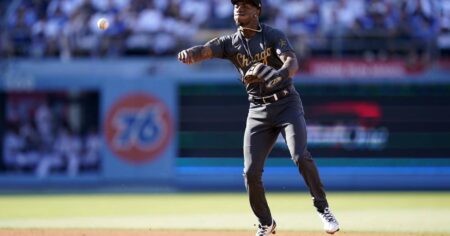
LOS ANGELES — The night began with Denzel Washington honoring Jackie Robinson.Moments later, members of the National League and American League teams gathered near home plate at Dodger Stadium, where Mookie Betts led the crowd in wishing Rachel Robinson a happy 100th birthday.AdvertisementThere were big cheers when Clayton Kershaw of the hometown Los Angeles Dodgers struck out New York Yankees slugger Aaron Judge.Judge’s Yankees teammate Giancarlo Stanton provided the power with a two-run homer in the fourth against another Dodgers pitcher, Tony Gonsolin. Byron Buxton of the Minnesota Twins followed with a homer to left.AdvertisementIt was the seventh set of back-to-back homers in All-Star Game history, and they were enough to lead the American League to a 3-2 win in front of 52,518.The Chicago White Sox had two players on the AL roster — Tim Anderson, who started at shortstop, and closer Liam Hendriks — and the Chicago Cubs had two on the NL squad in starting catcher Willson Contreras and outfielder Ian Happ.Here’s how the game went for the players from both teams.After just missing out on a chance to hit in his first All-Star Game last year in Denver — he was on deck in the ninth inning — Anderson made the most of being voted a starter this year. He went 1-for-2 with a single to left in the fourth.Anderson was the first Sox player to start at shortstop in the All-Star Game since Luis Aparicio in 1970, and he was involved in the action in the first inning, taking part in a tremendous double play.Cleveland Guardians second baseman Andrés Giménez went to his backhand to field Manny Machado’s hard-hit grounder. Giménez made a behind-the-back flip to Anderson, who threw to first to complete the double play.Anderson squared off against Sandy Alcantara of the Miami Marlins in his first at-bat, grounding out to first to end the second inning.Anderson ranged to his left to make a nice play in the third, fielding and throwing out Machado.AdvertisementHe came up during the AL’s three-run fourth, following the back-to-back homers with the single to left against Gonsolin. Xander Bogaerts of the Boston Red Sox replaced Anderson at shortstop in the bottom of the fourth.“It’s such a blessing to be right in the mix,” he told the Tribune before the game.Hendriks earned the save in last year’s game at Coors Field.“I want to make sure that every person who hasn’t been part of the game has an opportunity before I do,” Hendriks, also an All-Star in 2019 with the Oakland Athletics, told the Tribune before Tuesday’s game. “If an opportunity arises, an opportunity arises.”An opportunity arose in the eighth when Hendriks entered with two outs and a runner on first. He faced Travis d’Arnaud and got the Atlanta Braves catcher to fly out to center.He screamed, “Julio,” as in Julio Rodríguez of the Seattle Mariners, who made the catch. He waved while asking for the ball.AdvertisementHendriks hugged AL manager Dusty Baker when he made it to the dugout.Willson and William Contreras became the first pair of brothers since Roberto and Sandy Alomar Jr. in 1992 to start an All-Star Game together. Willson batted sixth in the NL lineup and William seventh.Willson came up in the first and struck out swinging against starter Shane McClanahan of the Tampa Bay Rays. William struck out looking against Alex Manoah of the Toronto Blue Jays to begin the second.Facing the A’s Paul Blackburn in the fourth, Willson reached on a fielding error by Guardians third baseman José Ramírez. William didn’t get the chance to drive in his brother, as he was lifted for Albert Pujols.Willson exited after the fifth, replaced by d’Arnaud behind the plate. Happ made his first All-Star appearance, entering in the sixth at center field. Next to him in left was former Cub Kyle Schwarber.AdvertisementHapp batted with two outs in the seventh against Gregory Soto of the Detroit Tigers. He worked a full count before drawing a walk.Happ was on deck when Jake Cronenworth struck out to end the game.
Byron Buxton, right, of the Twins, is greeted near home plate by American League teammate Tim Anderson of the White Sox after hitting a solo home run during the fourth inning of the MLB All-Star Game on July 19, 2022, at Dodger Stadium. (Mark J. Terrill / AP)
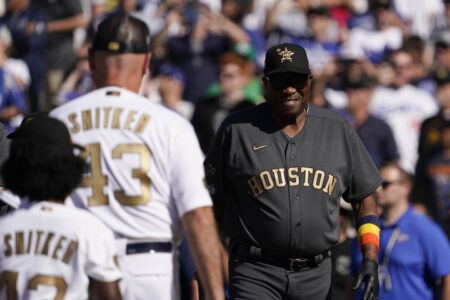
Monday at Dodger Stadium represented some of the best baseball has to offer.The legacy of the game was honored with the presence and performance of St. Louis Cardinals great Albert Pujols during the Home Run Derby. And one of the current faces of the game, Washington Nationals outfielder Juan Soto, won the event by topping Seattle Mariners rookie Julio Rodríguez in the finals.Advertisement“To say we’re excited about where our young guys are, where our game is, our veteran players, what they’re accomplishing on the field, is an understatement,” Major League Baseball Players Association executive director Tony Clark said during a Q&A session with members of the Baseball Writers’ Association of America on Tuesday in downtown Los Angeles.“I’m sure you can appreciate Albert Pujols, one of the greatest players that has ever played our game, being part of the festivities here in L.A. as well as some of the most talented young players that we have had in some time on the field at the same time.Advertisement“To say I’m excited where the game is, what our players are doing, is an understatement.”[ [Don’t miss] Who is a must-see — or did they all drop out? And does Joe Buck need to be muted? What to know about the MLB All-Star Game in Los Angeles. ]Commissioner Rob Manfred said he was “really pleased with how the first half has gone.”“We’ve had those milestones that are so important to our game,” said Manfred, who followed Clark in meeting with the BBWAA. “Miguel Cabrera particularly being in the middle of that (with his 3,000th career hit). Our best stars like (Los Angeles Angels two-way star Shohei) Ohtani continue to shine for the game.“And it’s another year of the young player. That’s great for the game.”Those accomplishments happened after a lockout delayed the season. As part of the agreement that ended the lockout, a competition committee was created that reportedly consists of six management officials, four union representatives and one umpire.What might look different in 2023?American League manager Dusty Baker, right, of the Houston Astros approaches National League manager Brian Snitker (43) of the Atlanta Braves during introductions before the MLB All-Star Game on Tuesday, July 19, 2022, in Los Angeles. (Mark J. Terrill/AP)A pitch clock, enlarged bases and limits on defensive shifts are the focal points for consideration, Clark said.“Every time you change something, it’s going to look slightly different,” Chicago White Sox closer Liam Hendriks told the Tribune before Tuesday’s All-Star Game at Dodger Stadium. “I dealt with the pitch clocks in the minor leagues. I think it’s something you can implement but not necessarily enforce. Advertisement“That is hopefully a decent indicator of the way things will go. You can put it up there but not necessarily enforce it. … Put it up and remind guys that they’re trying to. And it may be that reorganization that ‘I’m taking longer than I think.’“As far as the bigger bases, it will be interesting to see who that benefits the most. Whether it be bang-bang plays that they’re out or stolen bases that they’re safe. Who knows?”[ [Don’t miss] What we heard from Cubs and White Sox All-Stars, including Willson Contreras’ ‘experience that we will never forget’ ]One topic not currently being discussed is an automated ball-strike system.“We assume at some point in time it would become part of the conversation; it wouldn’t be for 2023,” Clark said. “It would perhaps be for 2024. But players have weighed in for some time and are very opinionated about the system. About what it may do, what it may not do.“Guys are offering tangible evidence about what it’s doing and what it may do moving forward with the game and are taking positions accordingly.”Some of the potential changes have been implemented and tested in the minors.AdvertisementFans hope to catch home run balls in the bleacher seats during batting practice before the MLB All-Star Game on Tuesday, July 19, 2022, in Los Angeles. (Jae C. Hong/AP)A separate topic of minor-league pay arose during Tuesday’s session with Manfred, who said, “I reject the premise that they’re not paid a living wage.”That drew a response from Advocates for Minor Leaguers executive director Harry Marino, who said in a statement: “Most minor league baseball players work second jobs because their annual salaries are insufficient to make ends meet. The commissioner makes an annual salary of $17.5 million. His suggestion that minor league pay is acceptable is both callous and false.”Manfred acknowledged that attendance is at “95% of where we were pre-pandemic.”“We have work to do,” he said. “To be 95% of where we were in 2019 is not our goal. Our goal is to be higher than we were in 2019. We need to work hard on things like pricing, promotion to make sure we get as many people as possible in the ballpark.”[ [Don’t miss] Column: Ranking all 30 MLB teams heading into the All-Star break. Where do the White Sox and Cubs stand? ]There might be new ballparks — and teams — on the horizon in the form of expansion.“Growing the game, we are a big fan of,” Clark said. “Expansion, we would be a fan of. We’ve been having the expansion conversation it seems like for a long time now. Making sure that the team in Oakland and the team in Tampa are situated is important. We’re hopeful that during the course of this five-year window that those things are settled and we can find ourselves in a world of 32 teams.Advertisement“I’m a head of a labor union, so I like it when jobs are added. But what would be great, too, is if those teams that are added, that there is a commitment to fielding the best team possible so we’re not just adding teams. Where every fan can come to the ballpark every day of every year and believe that their club is putting its best foot forward.”As for a timeline for expansion, Manfred said: “I need to get Oakland and Tampa resolved before we can realistically have a conversation about expansion. Those situations in my view are serious enough and timely enough, they have to be our No. 1 focus.”Shohei Ohtani runs to first base as he singles against Clayton Kershaw during the first inning of the MLB All-Star Game on Tuesday, July 19, 2022, in Los Angeles. (Jae C. Hong/AP)The focus Tuesday night was on many of the game’s best players gathering at Dodger Stadium. The game began with Ohtani at the plate and three-time National League Cy Young Award winner Clayton Kershaw of the hometown Dodgers on the mound.Change was even a possibility in the All-Star Game, with MLB announcing a home run derby would take place if the game is tied after nine innings.But don’t expect to see that in the regular season anytime soon.“I don’t see the derby-type format as something we can use beyond the All-Star Game,” Manfred said. “I think it’s something that could be exciting for the fans for a one-off event. I don’t see it as a regular-season undertaking.”AdvertisementAs for situations such as the current extra-innings format with a runner starting each half-inning on second base, Manfred said: “Visiting and revising rules should be an ongoing process in the competition committee. That’s why we’re so interested in the change we made in the basic agreement.”
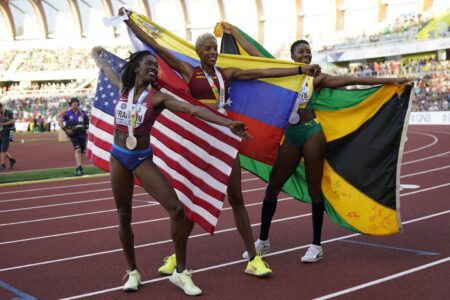
Westmont native Tori Franklin became the first U.S. woman to medal in the triple jump at the track and field world championships

Imagine cars racing down Lake Shore Drive at 130 mph, burning rubber on South Michigan Avenue and jockeying for position