


Author: staff


Phoenix Suns coach Monty Williams said the NBA should consider having a special section in the stands reserved for the families of visiting teams in the wake of Chris Paul’s family being harassed during Sunday’s playoff game in Dallas.The incident happened during Game 4 of the Western Conference semifinals between the Dallas Mavericks and Suns.AdvertisementESPN reported that members of Paul’s family had been harassed by fans and that some in the crowd made physical contact with them. The Mavericks said the fan was ejected.“It’s a hard one, because it’s happening more and more,” Williams said Monday at practice. “The situations are getting to a place now where I really feel like families, who are there to support their loved ones, need to be protected a bit more. Whether or not we have to give these people a section, a suite, something has to be done.Advertisement“Because we can’t wait for it to get to a level or two higher, before we do what we need to do. Yesterday was unnecessary.”The Mavericks said after the game they were aware of the incident between a fan and Paul’s family at American Airlines Center. Williams said he didn’t know the extent of the harassment in real time because the game was still being played.Phoenix Suns head coach Monty Williams, l, greets, Chris Paul at the bench after Paul fouled out in the second half of Game 4. (Tony Gutierrez/AP)The Mavericks said in a statement on Monday the offending fans had been banned from the arena for eight months.“American Airlines Center and Dallas Mavericks security and executives have concluded the investigation into the incident involving the Paul family,” the statement said. “Two unruly fans attempted to give unwanted hugs and have conversations with members of the Paul family on the public concourse of American Airlines Center. AAC security responded immediately once notified by the family and the fans were swiftly ejected from the game. The fans involved in the incident will not be allowed to return to the arena until 2023.”After the game, Paul tweeted: “Wanna fine players for saying stuff to the fans but the fans can put they hands on our families.” He also added an expletive.Paul didn’t speak to the media after Monday’s practice.The NBA has had several moments of conflict between fans and players or their families over the past few seasons, including an incident earlier this season when LeBron James had two fans ejected in a game in Indiana.Suns forward Cam Johnson said a similar situation happened in Milwaukee last season during the NBA Finals when his girlfriend was hit in the back of the head and had beer spilled on her. Johnson said he didn’t hear about it until after the game.Advertisement“It was kind of a big scene,” Johnson said. “It really frustrated me.”Johnson said security in Milwaukee handled the situation and that the fan was kicked out. He said security can only do so much to keep families safe.“A large part of the responsibility has to be on fans,” Johnson said. “They just can’t act that way. There’s no other way around it. You’ve got to address the problem with the real problem. It’s that a fan can’t go up to someone’s mother and harass them.”On Sunday, the Mavericks beat the Suns 111-101 and evened the best-of-seven series 2-2. Paul fouled out of the game in the fourth quarter. Game 5 is Tuesday night in Phoenix.“I have to stress that I don’t think this is indicative of the fans in Dallas,” Williams said. “They’re cheering for their team. I’ve never had this kind of incident at that arena, even going back to the old spot, Reunion Arena, never.”

When everyone predicted last month the Chicago White Sox would run away with the American League Central, general manager Rick Hahn voiced concern about the possibility of getting off to a “little rocky” start.“Just the nature of the offseason, the shortened spring, the steep schedule expectations early in the year were going to create some volatility in the roster and likely in performance,” Hahn said Monday afternoon. “I didn’t quite foresee losing eight in a row followed by (winning) six in a row. But it’s not a total shock that we haven’t quite found our sea legs or that this team hasn’t quite found its identity.”AdvertisementActually this Sox team already had an identity, forged during its run to the postseason in 2021. But only lately have we seen that cocky, us-against-the-world attitude on display.A six-game winning streak will do that, and the return of third baseman Yoán Moncada and reliever Joe Kelly from the injured list Monday only added to the team’s swagger.AdvertisementThe switch-hitting Moncada might not solve all of their early issues hitting right-handers, and Kelly must prove he’s totally back about 6½ months after incurring a right biceps nerve injury for the Los Angeles Dodgers in the National League Championship Series. Still, they’re two valuable ingredients to this White Sox stew.The Sox came home to summerlike weather Monday to begin a homestand against the Cleveland Guardians and New York Yankees. Michael Kopech, who has dominated since joining the rotation after his sabbatical in the bullpen last season, took the mound against the Guardians in search of his first win.[ [Don’t miss] Michael Kopech continues to learn with each start for the White Sox. ‘His stuff is electric,’ says Tim Anderson. ]It makes sense the Sox have handled Kopech with kid gloves — 23 innings in his first five starts — in spite of a sparkling 1.17 ERA. But does manager Tony La Russa foresee Kopech throwing into the eighth or ninth inning at all this season?“You’re fooling yourself or somebody if you predict what he’s going to get today,” La Russa said before Monday’s start. “If he’s cruising, he can pitch seven or eight if he’s having quick outs. If not, maybe half of that.“We know the reality is this is his first (full) year as a starter. It’s a long season and we’re going to err on the side of caution as far as extending him.”Kopech showed his frustration in the dugout after being removed in the fifth inning of his last start against the Cubs at Wrigley Field, though he later said he understood the Sox were looking out for his well-being.White Sox third baseman Yoán Moncada during batting practice before a game against the Cleveland Guardians at Guaranteed Rate Field on Monday, May 9, 2022. (Armando L. Sanchez / Chicago Tribune)It’s hard to come out when you’re almost unhittable. Kopech had limited right-handed hitters to a .114 average entering Monday’s game with no extra-base hits against him.“I don’t even think he’s brought anything near his ‘A’ game out yet, and he’s absolutely dominated guys,” fellow starter Dylan Cease said Monday. “When he’s clicking on all cylinders, it’s going to be scary.”AdvertisementCease, who may be on his way to his first All-Star selection, said Kopech is relearning how to be a regular starter for the first time since 2018. He missed all of 2019 after Tommy John surgery on his right elbow and sat out the pandemic-shortened 2020 season.“He’s obviously already a good pitcher, and he had done it for spurts out of the bullpen,” Cease said. “But now it’s the next step of getting through the lineup a couple times. He absolutely has the stuff to do it.”It has been a minute since Kopech and Moncada became the first two prospects Hahn acquired for the rebuild when he sent ace Chris Sale to the Boston Red Sox at the 2016 winter meetings. Injuries and COVID-19-related absences have prevented both players from living up to the early hype, but it’s easy to forget Moncada has played only four full seasons while Kopech had only eight career starts entering 2022.If the promised land is on the Sox docket, both players must be vital cogs on the ride.The Sox optioned Jake Burger to Triple-A Charlotte to open Moncada’s roster spot. Kelly took the place of reliever Aaron Bummer, who was placed on the IL retroactive to Saturday with a right knee sprain.“Just kind of a freak thing that happened in Boston,” Bummer said. “Just on the last two pitches felt something. We’re definitely playing it smart. We’re playing it safe this time of the year and not trying to push anything, and it’ll be healthy for the long run.”Advertisement[ [Don’t miss] The ‘Sodfather’ confirms the obvious: This Chicago spring — with its ‘brutal’ weather pattern— has been the worst ]Kelly’s health bears watching after Hahn signed the veteran in March to a two-year, $17 million deal with an option for 2024. Kelly once suffered a back injury cooking crawfish for his teammates in 2019.“He was cooking some Cajun food,” Dodgers manager Dave Roberts said. “I guess he was standing a little longer than he wanted to. That’s what he told me.”With their never-ending series of untimely injuries, the Sox hopefully can keep Kelly away from the stove in 2022. Hand him some takeout menus from our many fine restaurants.It couldn’t hurt. The Sox have become experts in overcoming obstacles the last two-plus seasons, and their early travails could be a mere blip come October.“One of the beautiful things about this game is over the course of a long summer, the true talent and true ability of the team tends to prevail,” Hahn said.Summer arrived early Monday, interrupting our miserable Chicago spring.AdvertisementWe can only hope it’s a long one.

Enough Chicago aldermen are in agreement on a new map of the city’s 50 wards that they will avoid a ballot referendum next month that would…

Eleven months after the NCAA lifted most of its restrictions against athletes cashing in on their fame, college sports leaders are trying to send a warning to schools and boosters they believe have crossed a line: There are still rules here and they will be enforced.But after last year’s Supreme Court ruling against the NCAA in an antitrust case, is a crackdown on so-called collectives brokering name, image and likeness deals likely — or even possible?Advertisement“I didn’t think (the NCAA) would not try at some point,” said Maddie Salamone, a sports attorney and former Duke lacrosse player. “That’s why many attorneys have been kind of giving cautious advice in terms of what is and is not allowed. Especially when it comes to collectives and different NIL deals.”The NCAA’s Division I Board of Directors on Monday approved guidance developed by a group of college sports administrators, clarifying the types of NIL payments and booster involvement that should be considered recruiting violations.Advertisement“Specifically, the guidance defines as a booster any third-party entity that promotes an athletics program, assists with recruiting or assists with providing benefits to recruits, enrolled student-athletes or their family members,” the NCAA release said. “The definition could include ‘collectives’ set up to funnel name, image and likeness deals to prospective student-athletes or enrolled student-athletes who might be considering transferring.”The NCAA added a reminder: Recruiting rules bar boosters from recruiting or providing benefits to prospects.The guidance is effective immediately. NCAA enforcement staff was directed to look for possible violations that might have occurred before May 9, 2022, but “pursue only those actions that clearly are contrary to the published interim policy, including the most severe violations of recruiting rules or payment for athletics performance.”The NCAA neither changed its rules nor created new ones.“I don’t think they’re even necessarily clarifying the rules,” said attorney Darren Heitner, who helped craft Florida’s NIL law. “My understanding is this is just certain individuals who have made up a working committee deciding that after almost 11 months we want to enforce our rules.”The rise of booster-funded collectives prompted the board in February to ask the DI Council to review the NCAA’s interim NIL policy. The concern among many in college sports has been that payments from collectives are being made to high school recruits and to college athletes in hopes of getting them to transfer to a particular school.“Some things look very much like pay-for-play,” Salamone said. “There are rules on the books within the NCAA around boosters. The fact that the NCAA has been hesitant to enforce anything I think has emboldened a lot of people around this issue to be a little bit more obvious.”Last year, the NCAA removed its longstanding ban against athletes earning money from sponsorship and endorsement deals. What remained in place, however, were three pillars of the NCAA’s amateur athlete model:AdvertisementAthletes could not be paid solely for playing their sport.Compensation could not be used to lure an athlete to a particular school.Financial arrangements must have some type of quid pro quo agreement in which the athlete was being paid for services provided, such as a social media post or an appearance.The NCAA did not ban boosters from being involved in NIL activity. However, without detailed NCAA rules and with state-level NIL laws differing across the country, it left both schools and the association struggling to determine which activities were impermissible.Some state laws also prohibit boosters from engaging with recruits, but there has been little appetite for enforcement of those laws.Should the NCAA start targeting some collectives, it could trigger a new round of lawsuits against the association.Mit Winter, a sports attorney in Kansas City, Missouri, said NCAA enforcement of these rules is not a clear-cut antitrust violation.“So the question is, under antitrust law, is the rule that’s being enforced reasonable?” Winter said. “And from my reading of everything, the rule that they’re going to be enforcing is the rule that says boosters and other third parties like collectives cannot pay athletes in return for a commitment to a school.”Chicago Tribune SportsWeekdaysA daily sports newsletter delivered to your inbox for your morning commute.Heitner advises several collectives and businesses that have made NIL deals with college athletes. He said he has stressed to clients from the start to wait until athletes are at the school of their choice before getting involved.Advertisement“I don’t think it’s a collective issue,” he added. “I think it’s just a matter of the NCAA saying, ‘Hey, we’ve always been of the position that boosters cannot influence decision making of athletes, particularly high school athletes who have not yet enrolled at universities.’”Gabe Feldman, the director of sports law at Tulane, said the NCAA would be best served being forward-looking with its NIL enforcement.“That probably is a safer and more fair approach,” Feldman said. “Hindsight is 20/20, but what might have been an even better approach is to have come up with clear rules earlier and started enforcing those so we didn’t get to a situation where it might be unfair to start enforcing the rules.”College sports conferences and the NCAA have been frequent targets for lawsuits, and last June’s Supreme Court ruling left the door open for even more.Feldman said the NCAA could be opening itself up to more antitrust exposure by failing to enforce its existing rules. But both antitrust lawsuits and NCAA enforcement are notoriously slow-moving.“This would be like the tortoise and the tortoise,” Feldman said. “Neither would get done quickly, but there’s a lot of risk in the interim.”

Two men were fatally shot in Humboldt Park near a playground Monday afternoon, according to Chicago police.About 3 p.m., the men, 34 and 35, were near…

Mayor Lori Lightfoot’s pick for Chicago’s decades-in-the-making casino was the subject of a grueling six-hour hearing Monday that saw some aldermen complain of a too-rushed selection…

Conserving energy and stargazing are two of many reasons people opt to turn their lights out at night, but over the next three days, experts are…

Illinois Supreme Court Justice Rita Garman, a Republican who two decades ago became only the second woman to sit on the state’s highest court and later…

A powerful and painstaking investigation into fatal fires that exposed flaws in Chicago’s building code enforcement and the permanent scars left on survivors has earned the…
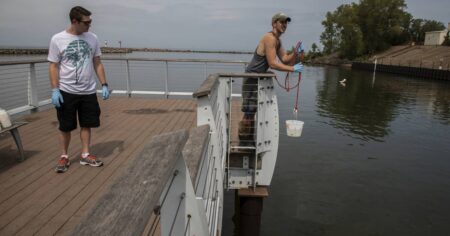
A federal judge approved an already-reached deal for an Indiana steelmaker to pay $3 million and upgrade equipment over a 2019 chemical spill that killed 3,000…