
Author: staff

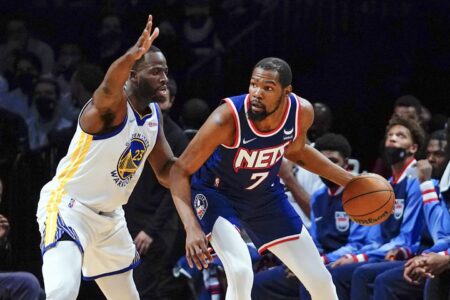
The Chicago Bulls spent the first night of free agency — which began at 5 p.m. Thursday — waiting on their biggest offseason question mark.Two-time All-Star guard Zach LaVine entered unrestricted free agency for the first time after helping the Bulls end a four-year playoff drought —and his first postseason appearance — last season. Although the Bulls front office has been optimistic about re-signing LaVine to a maximum deal, the two parties didn’t come to an agreement at the opening of free agency.AdvertisementLaVine must make a decision by July 7, when the free-agency window comes to a close.In the first bombshell move of the free-agency cycle, Kevin Durant requested a trade from the Brooklyn Nets after a disappointing three-season run in New York.AdvertisementThe Warriors’ Draymond Green, left, defends the Nets’ Kevin Durant on Nov. 16, 2021, in New York. (Frank Franklin II, AP)Despite heightened expectations surrounding the partnership between Durant and Kyrie Irving, the two were able to deliver on only one playoff-series win with the Nets. Irving chose to push for a trade out of Brooklyn despite opting in to the the final year of his $37 million contract extension, and Durant followed Thursday.Durant’s decision shakes up the power rankings of the Eastern Conference, which saw the Nets oscillate between bona fide contenders and flailing underachievers in recent seasons.Durant’s landing spot will be equally influential to the makeup of either conference next season. A one-time NBA MVP, two-time NBA champion, two-time NBA Finals MVP, four-time scoring champion and 12-time All-Star, Durant remains a prolific scorer with the ability to immediately transform a roster.

A former Brennemann Elementary School principal pleaded guilty Thursday to her alleged role in an overtime kickback scheme at the Buena Park neighborhood school, federal officials…
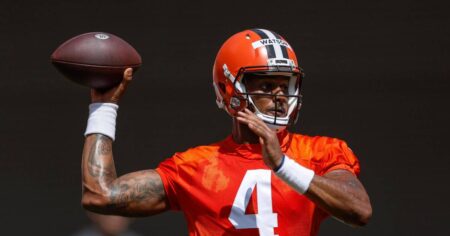
Deshaun Watson’s disciplinary hearing concluded Thursday with the NFL adamant about an indefinite suspension of at least one year and the quarterback’s legal team arguing there’s no basis for that punishment, two people with knowledge of the case told the Associated Press.Both sides presented their arguments over three days before former U.S. District Judge Sue Robinson in Delaware, according to both people who spoke on condition of anonymity because the hearing isn’t public.AdvertisementWatson, 26, was accused of sexual misconduct by 24 women and settled 20 of the civil lawsuits.Robinson, who was jointly appointed by the league and the NFL Players Association, will determine whether Watson violated the NFL’s personal conduct policy and whether to impose discipline.AdvertisementPost-hearing briefs are due the week of July 11, so it’s uncertain when Robinson will make a ruling. The Cleveland Browns are hoping to know Watson’s availability before training camp starts July 27.[ How the Houston Texans and a spa enabled Deshaun Watson’s massage appointments ]If either the union or league appeals Robinson’s decision, NFL Commissioner Roger Goodell or his designee “will issue a written decision that will constitute full, final and complete disposition of the dispute,” per terms of Article 46 in the collective bargaining agreement.A person familiar with the case told the AP the league believes it presented evidence to warrant keeping Watson off the field this season. The person said the league’s investigation determined Watson committed multiple violations of the personal conduct policy and he would be required to undergo counseling before returning.A person familiar with Watson’s defense told the AP they expect a suspension. Asked what would be acceptable, the person said: “Our goal is to get him back on the field this year.”Two separate Texas grand juries declined to indict Watson on criminal complaints stemming from the allegations. Watson has denied any wrongdoing and vowed to clear his name.This is the first hearing for Robinson, who was the first female chief judge for the District of Delaware. Previously, Goodell had the authority to impose discipline for violations of the personal conduct policy.

Over the past three years, Julie Contreras, an immigration and humanitarian activist from the Waukegan area, has visited the makeshift tent encampments filled with asylum-seekers on…

When Arcan Abu-hashish saw the black swastikas painted on his Jefferson Park smoke shop, he felt broken, he said, and scared.“I just wish he’d leave us…

Illinois and Chicago are receiving nearly 4,500 doses of a vaccine that can prevent monkeypox, from the national stockpile, amid a growing number of cases in…
Illinois and Chicago are receiving nearly 4,500 doses of a vaccine that can prevent monkeypox, from the national stockpile, amid a growing number of cases in…
Illinois leaders are making the case that the Chicago area should be home to a new $1 billion federal agency focused on health research.Fifteen members of…
Illinois leaders are making the case that the Chicago area should be home to a new $1 billion federal agency focused on health research.Fifteen members of…

The news of a possible defection by Pac-12 stalwarts USC and UCLA to the Big Ten Thursday sent shock waves throughout the college landscape. It’s the latest realignment move that could drastically change the look of college football in the future and it’s most likely not the last. Here are how several of the conferences stand after the latest round of realignment news:AdvertisementThe Big Ten could make the next move in conference realignment with the reported addition of USC and UCLA in 2024. What could be the ripple effect of that move? (Charlie Neibergall/AP)USC and UCLA could join the Big Ten by 2024, expanding the conference to 16 members and creating a footprint that extends from New Jersey to California. It includes lucrative television markets in New York, Chicago, Pittsburgh and Los Angeles. But some don’t believe the league is finished.With a new media rights deal in the works, now may be the time for the Big Ten to look to expand to 20 members. If so, there are a few choices, perhaps other Pac-12 schools like Oregon, Washington and Stanford or maybe the ultimate piece in Notre Dame. The school has relished its independence but could forgo it and join a conference.AdvertisementWhen Thursday’s news broke, the ink hadn’t even dried on new Big 12 commissioner Brett Yormark’s contract. Yormark won’t have long to get settled in before he faces more concerns over realignment. The DNA of the league is changing with the addition of four new schools in BYU, Cincinnati, Houston and UCF in 2023, even as the league is about to lose blue blood programs in Texas and Oklahoma in 2025. With a new media rights deal on the horizon, perhaps now is the time to get aggressive. The Pac-12 is on shaky ground at best and the Big 12 could provide more value to television partners by adding schools like Arizona and Arizona State. Or Yormark could shoot higher and propose a merger with the remaining Pac-12 members, forming a super conference with 20 or 22 members. When the SEC decided to invite Texas and Oklahoma to join the league, it started the first wave of conference realignment moves that have led to the Big Ten reportedly adding USC and UCLA. (Mike Ehrmann/Getty Images North America/TNS)The SEC started this process by inviting Texas and Oklahoma to join the league in 2025. It’s a move projected to pay each league member $117 million of revenue by 2029. That would be most in the Power Five conferences, ahead of the Big Ten’s projected $100 million. If the SEC wanted to continue to grow, it could look toward the ACC, where schools like Clemson, Florida State, Miami and North Carolina would fit its southern footprint. The only catch would be the ACC’s Grant of Rights, which runs through 2036. Although if eager to leave, the schools could try their luck through legal challenges. Realignment hasn’t been as real as it is now for the ACC. The league has several attractive member schools (See SEC) and if its Grant of Rights is nullified through the courts, it’s anybody’s guess what could happen. Chicago Tribune SportsWeekdaysA daily sports newsletter delivered to your inbox for your morning commute.That doesn’t mean the ACC could choose to stay pat. The league could pursue Notre Dame, trying to convince the school to join as a full-fledged member instead of just a partial member. The addition of the Fighting Irish football program could go far in solidifying the conference. If the ACC chooses to expand, it runs the risk of nullifying its Grant of Rights deal, which would open the door for schools to leave without penalty. AdvertisementPac-12 commissioner George Kliavkoff thought forming the Alliance between the Big Ten and ACC would help solidify his conference standing. That’s clearly out the window with Thursday’s news. Barring a last-second Hail Mary by Kliavkoff to convince USC and UCLA to have a change of heart, the league’s standing is tenuous at best. Even with the two L.A. schools, the league was only projected to see its revenue per school grow to $62 million by 2029, and without them, that figure would surely be much less. The Pac-12 could stay put with its remaining 10 member schools, or it can add new schools like Boise State, Fresno State or San Diego State. But those wouldn’t provide enough cache to convince the other schools not to look elsewhere. If schools like Oregon, Washington and Stanford are convinced to join a league like the Big Ten, then all bets are off. It’s safe to say that the five non-autonomous conferences are playing the waiting game. What inevitably happens to the Pac-12 would have a ripple effect that could stretch into the G5 landscape. This article first appeared on OrlandoSentinel.com. Email Matt Murschel at mmurschel@orlandosentinel.com or follow him on Twitter at @osmattmurschel.