


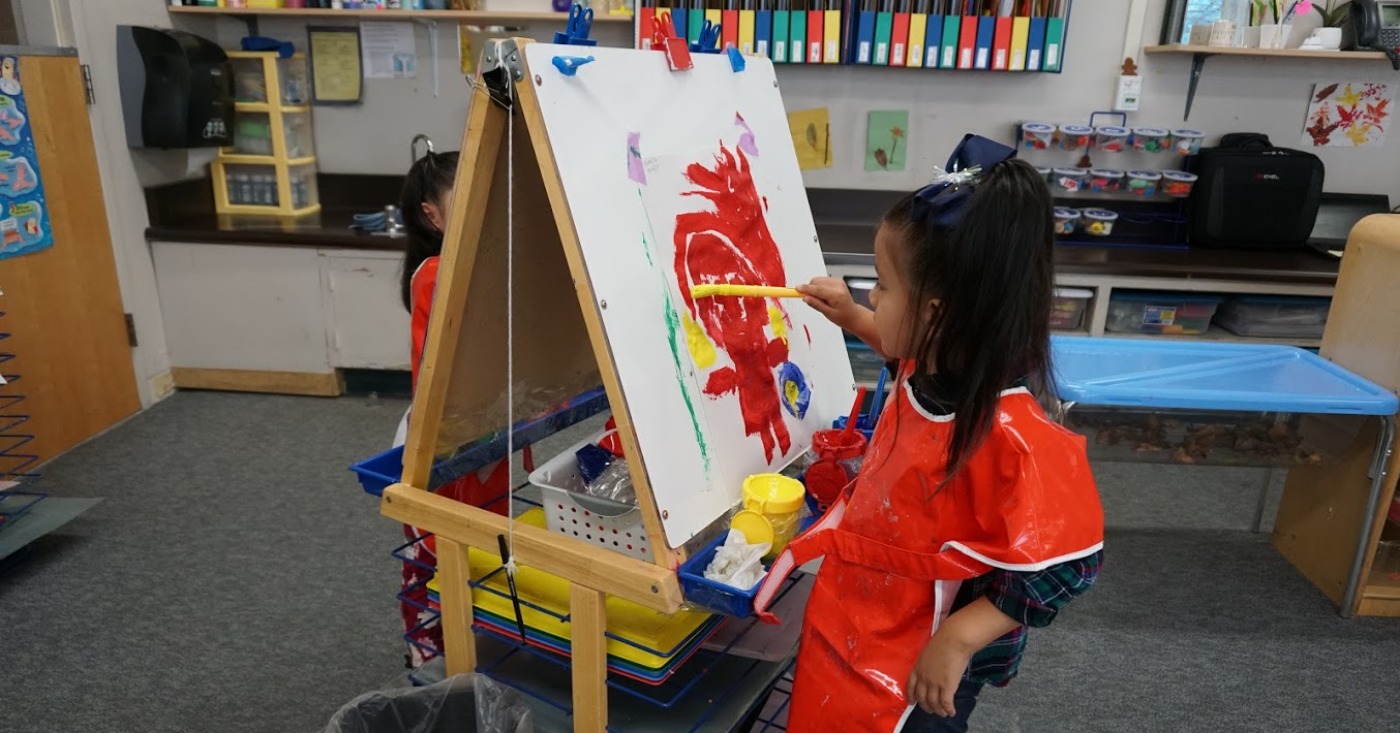
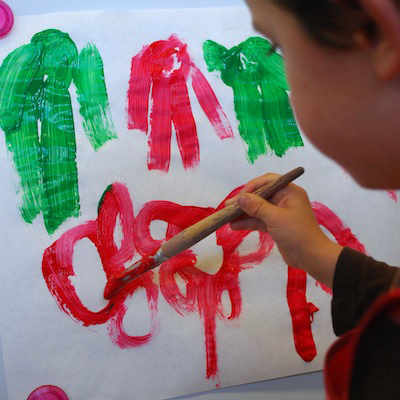
Singing the ABC song. Learning the days of the week from a nursery rhyme. Making a finger-painted collage of little handprints.
Arts education has always been center stage in early education because little children are naturally creative, filled with wonder and the burning desire to express themselves. Arts and crafts not only help nurture a child’s natural imagination, they also boost small motor skills, sharpen hand-eye coordination and feed the insatiable need to play.
“Children don’t just play, they learn fundamental skills through play,” said Daniel Mendoza, a California visual artist and specialist in early childhood education art practices. “Children are in a creative mindset all the time.”
While this may well be as true for teenagers as it is for toddlers, there is far more time and space allotted for playfulness in the early grades, when the crucial role of play in particular and creativity in general has long been a matter of common sense.
“Really, I’m just a common-sense professor, and somehow it became rogue,” said Kathryn Hirsh-Pasek, a professor of psychology at Temple University and an expert in the key role of play in learning. “What if we taught children the way we know the brain learns?”
Bringing joy back into the classroom is also what motivates Cindy Hoisington, an early childhood expert who specializes in reaching out to children from historically marginalized communities at the Education Development Center (EDC), a national education nonprofit.
“This is not anything new, knowing that play is so critical to children, whether it’s dramatic play, building play, creative arts play or physical play,” said Hoisington, a STEM expert who taught preschool for decades. “But as soon as they hit kindergarten and first grade, there’s this dichotomy that sets in. Play is something you get to do after you do the learning when, in fact, we know that play is an incredible vehicle for learning.”
Play, some experts suggest, may be the superpower of the young. A growing body of research suggests that play may even be a way to help close achievement gaps. One report, analyzing 26 studies from 18 countries, found that in communities from Rwanda to Ethiopia, children got higher learning boosts in literacy, motor skills and social-emotional development when attending child care centers that use a mix of instruction and free play as opposed to those focused solely on academics.
“Children are so naturally, intuitively ready with their curiosity, their motivation to explore the world and everything in it, to the point where that’s why the twos are so terrible, because you’re constantly chasing after them,” said Hoisington, who helps evaluate digital media for PBS. “Science, for instance, tends to have a bad rap as this dry body of knowledge that we have to learn, but really it’s a process of exploration that is very much integral with play.”
Tapping into that spirit of discovery with hands-on experiences is often best, experts say. Curiosity burns brightest in the early years, so letting kids loose to investigate the world is part of building a rich, play-based learning environment.
“Where young children are free to investigate by observing, touching and acting on the objects in their world,” said Deborah Stipek, an expert in early childhood at Stanford University. “This is how they learn about the world — for example, that some objects float and some sink. Through their own experimentation and observation, they may even arrive at hypotheses about the qualities that differentiate the two.”
From “The Wheels on the Bus” to “Baby Shark,” kiddos love to sing and love to learn, so why not teach through music? Singing the “Old MacDonald had a Farm” song can be educational, experts say, as well as a ritual for community building. Children can take turns deciding on which animal to pick, which builds vocabulary as well as sharing skills.
“Young children learn best by doing,” said Stipek. “Counting objects is better than counting dots on a worksheet because they can move the objects to help them keep track of how many they have counted. Worksheets are not all bad. They can provide opportunities to practice and consolidate skills. But children don’t develop new skills doing worksheets, and they are typically not nearly as engaging and fun.”
Tracing the alphabet in shaving cream or making tin-foil sculptures may seem like basic exercises, but they often teach sophisticated concepts. Playing make-believe games can teach numerous skills at once. Pretend restaurants need someone to write a menu, calculate a bill and greet diners, fostering literacy, numeracy and special-emotional learning all in one game, Hoisington notes.
Songs are a clever way to remember stuff because they make memorization easy and fun for little ones. Melodies and rhymes make the most of our limited working memory to help children embed basic facts into their long-term memory, bolstering depth of cognition.
“I still sing the ABC song in my head sometimes, if I want to know which letter comes before which letter,” admits Hoisington.
What’s often missed in the discussion of the role of play is that older children also need time for creativity and free play, as well as the arts. While there is much talk about the need to engage students, there is little focus on low-hanging fruit like increasing time for arts, sports and recess. Putting too much emphasis on academic skills in isolation undercuts the love of learning, some warn.
“Kids try to buck it, but certainly by first grade we’ve started to ruin them,” said Hirsh-Pasek. “We pound the curiosity right out of kids.”
Mendoza firmly believes teachers should be guides to adventure instead of taskmasters.
“You don’t have to be a dictator,” as he puts it, “you can be a Sherpa.”
So, why doesn’t the role of play get more respect in education? Why do we emphasize test scores over deep learning?
“We got to this place because people are scared,” said Hirsh-Pasek. “They’re feeling like they’re losing control, and they want to make sure their kid is ahead. We push it younger and younger and younger, and as we do that, we’re creating a situation where our kids are anxious wrecks and the parents are anxious wrecks.”
Some experts suggest that children need more time for play and creativity in the wake of the pandemic, not less. Credit: Lillian Mongeau / EdSource
Too few teachers and parents are aware that play helps build the architecture of the growing brain, experts say.
“Play is not frivolous; it enhances brain structure and function and promotes executive function (i.e., the process of learning, rather than the content), which allow us to pursue goals and ignore distractions,” as an American Academy of Pediatrics report put it. “When play and safe, stable, nurturing relationships are missing in a child’s life, toxic stress can disrupt the development of executive function and the learning of prosocial behavior; in the presence of childhood adversity, play becomes even more important.”
Some experts fear that the laser focus on falling test scores in recent years has led to a decrease in playful learning. They suggest that children need more time for play in the wake of the pandemic, not less. Amid the crisis of chronic absenteeism, engaging students on a compelling level may be more vital than ever.
Creativity is the secret formula, experts say, in a world where machines will always compute faster than humans. Drill and kill won’t help children master high-level intellectual inquiry and conceptual analysis.
“You have to ask yourself, what’s it going to take to outsmart the robots?” as Hirsh-Pasek put it. “We need kids who don’t just memorize and take tests well, which AI will do better than our kids ever will. We need kids to be explorers and problem solvers.”