


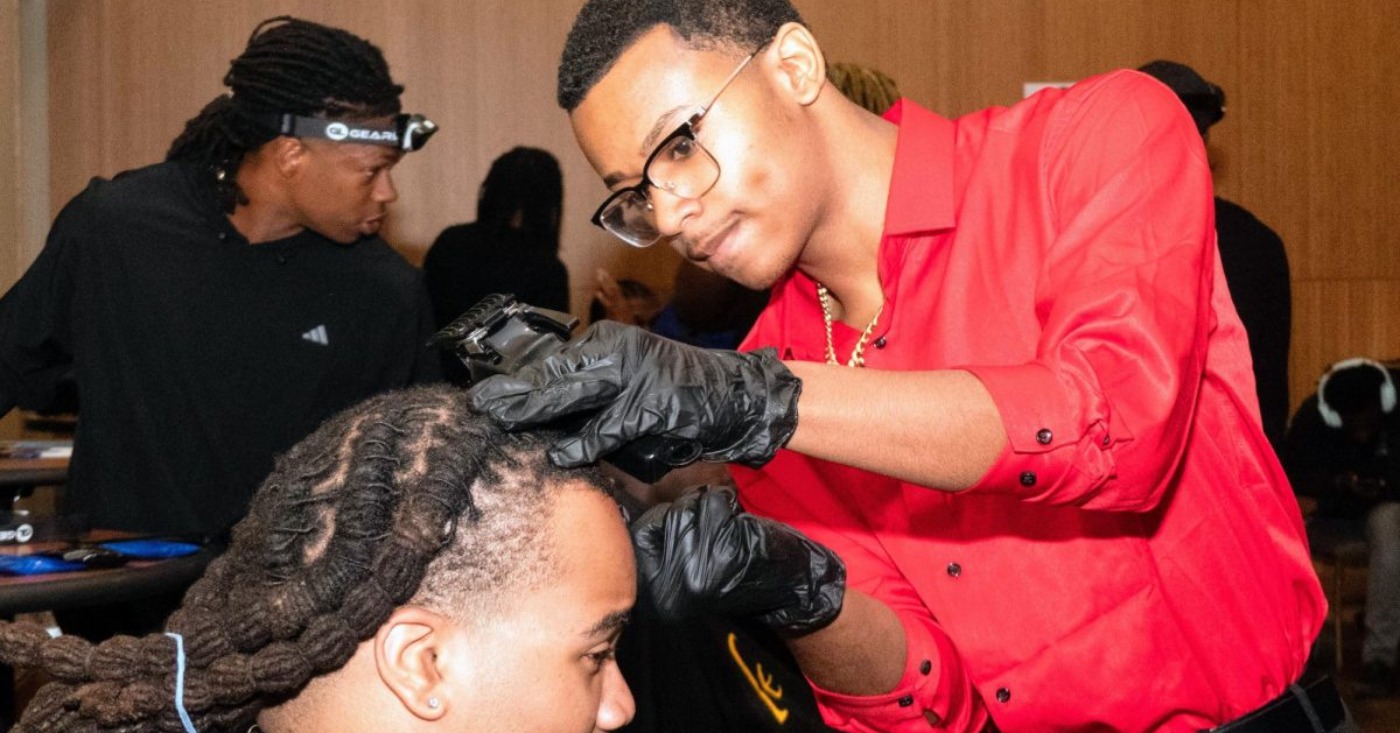
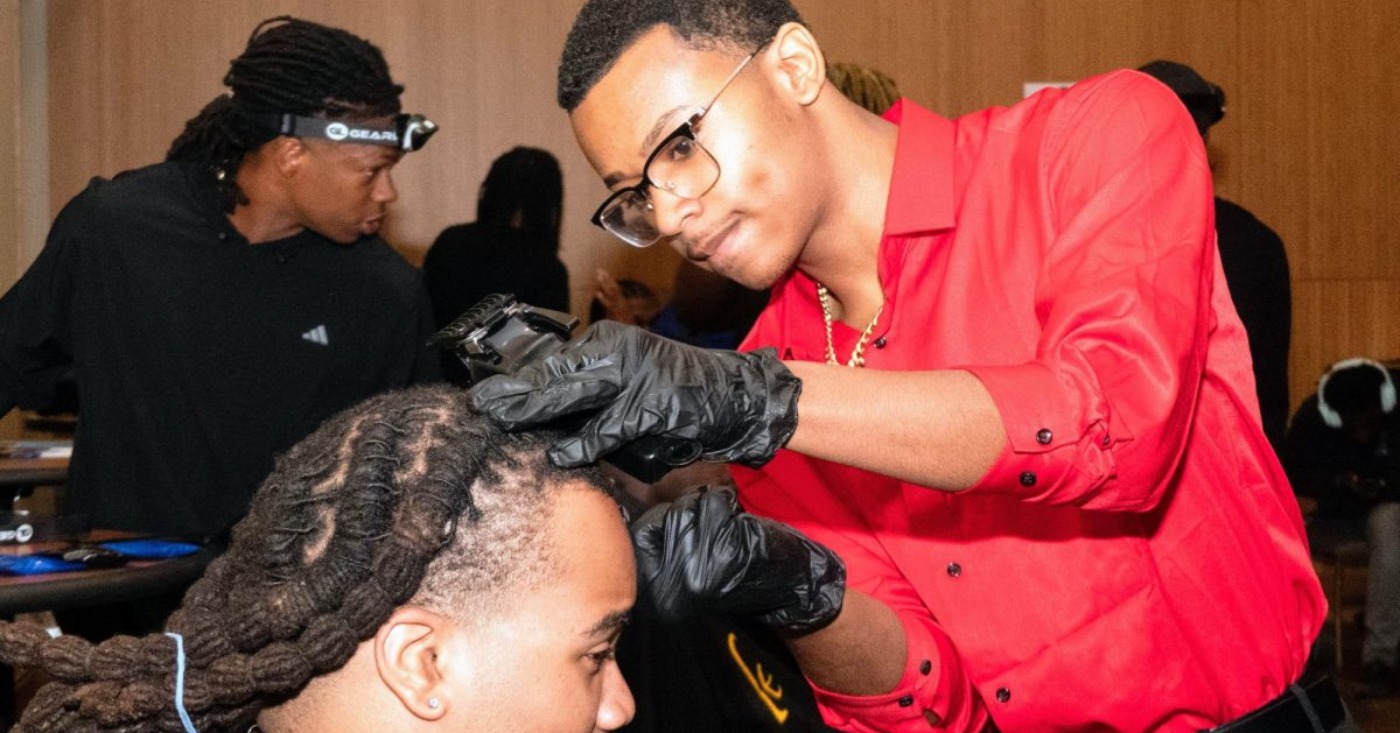
The sound of clippers buzzed with a different kind of conversation Monday at 11 a.m. as Alabama State University students and staff listened to barbers, cancer survivors and health professionals discuss a disease that disproportionately affects Black men.
Cuts and Conversations, held Sept. 28 in the John Garrick Hardy Center Ballroom, used free haircuts and the familiarity of the barbershop to open conversations about prostate cancer, early detection, family history and men’s health.
Tanjula Petty, Ed.D., vice president for Institutional Effectiveness, Strategic Initiatives and Transformation, and Willie S. Rockward, Ph.D., dean of the College of Science, Technology, Engineering and Mathematics, opened the forum and welcomed those in attendance.
For Petty, the message came from experience.
“I’m not just speaking to you based on research,” she said. “I’m talking to you from a place of experience.”
Petty said she exercised regularly, ate well and considered herself healthy when a doctor told her she had cancer. She challenged students to take what they learned back to their fathers, grandfathers and uncles.
“It’s not all about genetics; you may be the first in your family to experience it,” Petty said. “People ask me all the time, ‘Who in your family was diagnosed?’ Nobody. I’m the first.”
According to the Centers for Disease Control and Prevention, Black men are more likely to develop prostate cancer than other men and are more than twice as likely to die from the disease. The American Cancer Society recommends that Black men begin discussing prostate cancer screening with a health care provider at age 45 or at 40 for men at higher risk because of family history.
Three prostate cancer survivors were recognized during the event: Andy Maxwell, Leroy Huffman and Dandrea Evans Sr. Evans and Huffman shared their experiences with those in attendance.
Evans was 44 when a routine doctor’s visit led to his prostate cancer diagnosis. He had no symptoms.
“Initially it was the worst news you could ever hear because I didn’t feel like I had cancer. I felt great,” he said.
Evans said he turned to his faith and made the decision “to trust God through the process and to live.” Four years later, he said he is cancer-free.
“The more you know, the more you’ll be prepared to deal with it and understand it a little bit better,” Evans said.
The five-year survival rate is greater than 99% for prostate cancer diagnosed at a localized or regional stage, according to the American Cancer Society. That rate falls to 38% when the cancer has spread to distant parts of the body.
Huffman has worked at Heritage Barber & Style Shop for about 26 years, has cut hair for 63 years.
“Awareness about prostate cancer is the best thing that Black men should do,” Huffman said.
His advice was simple.
“Age is not the key here. Life is,” Huffman said.
Dawna Nelson, Ph.D., an associate professor of social work, licensed master social worker, and principal investigator for the Cuts and Conversations research project, said the project grew from years of community health work and conversations with Heritage about the role barbershops already play in Black communities. When funding became available, the partnership trained barbers to speak with clients about prostate cancer, early detection, and family history.
Heritage owner Vladimir “Boo Man” Averett said the shop wanted to be part of that work, particularly because of Huffman’s experience.
“He gives conversation all the time to us younger barbers as well as our clients about get checked, get checked, get checked,” Averett said.
For Averett, the message comes down to five words.
“It’s not about wealth. It’s about health,” Averett said.
The partnership extended to student barbers.
Brittany Hollins, planning and evaluation specialist in the Office of Institutional Effectiveness, Strategic Initiatives, and Transformation, said organizers worked with Student Life and athletics to identify student barbers who were trained at Heritage to carry those conversations to their peers.
“They’re cutting hair, and they’re having these conversations,” Hollins said. “And so it’s Cuts and Conversations today.”
Hollins’ grandfather died a little more than a year ago after his prostate cancer progressed to Stage 4.
“It is not an easy task to have that loved one at home on hospice, and you are being tasked to give them that last dose of morphine, and then you realize there’s no pulse,” Hollins said.
Beyond the personal stories, the event connected students with cancer research and health resources.
Manoj K. Mishra, Ph.D., director of the university’s Cancer Research Center and professor of biology, said the center supports cancer research, trains students, and works to increase cancer awareness in the community.
Pastor Lee B. Walker Jr. and Terrance “Wolfgang” Baldwin hosted a live recording of the “Off the Cuff” podcast, continuing the discussion about prostate cancer awareness and Black men’s health.
Five Horizons Health Services, the Alabama Department of Public Health, the university’s Cancer Research Center and Health Services were represented. Five Horizons also provided free HIV and sexually transmitted infection testing.
For the students in the barber chairs, the conversations made the message immediate.
Freshman Jonathan Alexandre said events such as Cuts and Conversations can make it easier for young Black men to begin talking about their health.
Freshman Elijah Kidd, a computer engineering major from Pensacola, Florida, said cancer has already touched his family through his uncle.
“Really just cherish every moment you have, because you never know when it might end,” Kidd said.
Senior Xavier Moore, a double major in music education and music performance, said the setting allowed younger and older Black men to learn from one another.
“Your health comes first,” Moore said.
Student barber Mark Coaxum II, a biology major who plans to become a doctor, brought the message back to action.
“Knowing the probability is good, but getting tested is best, because whether you’re probable or not, you never know,” Coaxum said. “It could be you.”
Nelson said she hopes those conversations continue long after the barber chairs are gone.
“The barbershop is where these conversations start, but then the next day they’re in the gym, and then the day after that on the golf course, and in the boardroom, and most importantly, at a family dinner table amongst the father and the son,” Nelson said.
For students who may think prostate cancer is years away, Nelson left them with a reason to start talking now.
“You are a son. You are a nephew. You are a grandson,” she said. “And if you take the time to talk to your fathers and your uncles and all of the men in your life about this, you are potentially saving their life, and you’re also at the same time empowering yourself so that when your time does come, you have all the information you need to be able to make good health choices.”
Based on reporting by Alabama State University – The Hornet Tribune.