


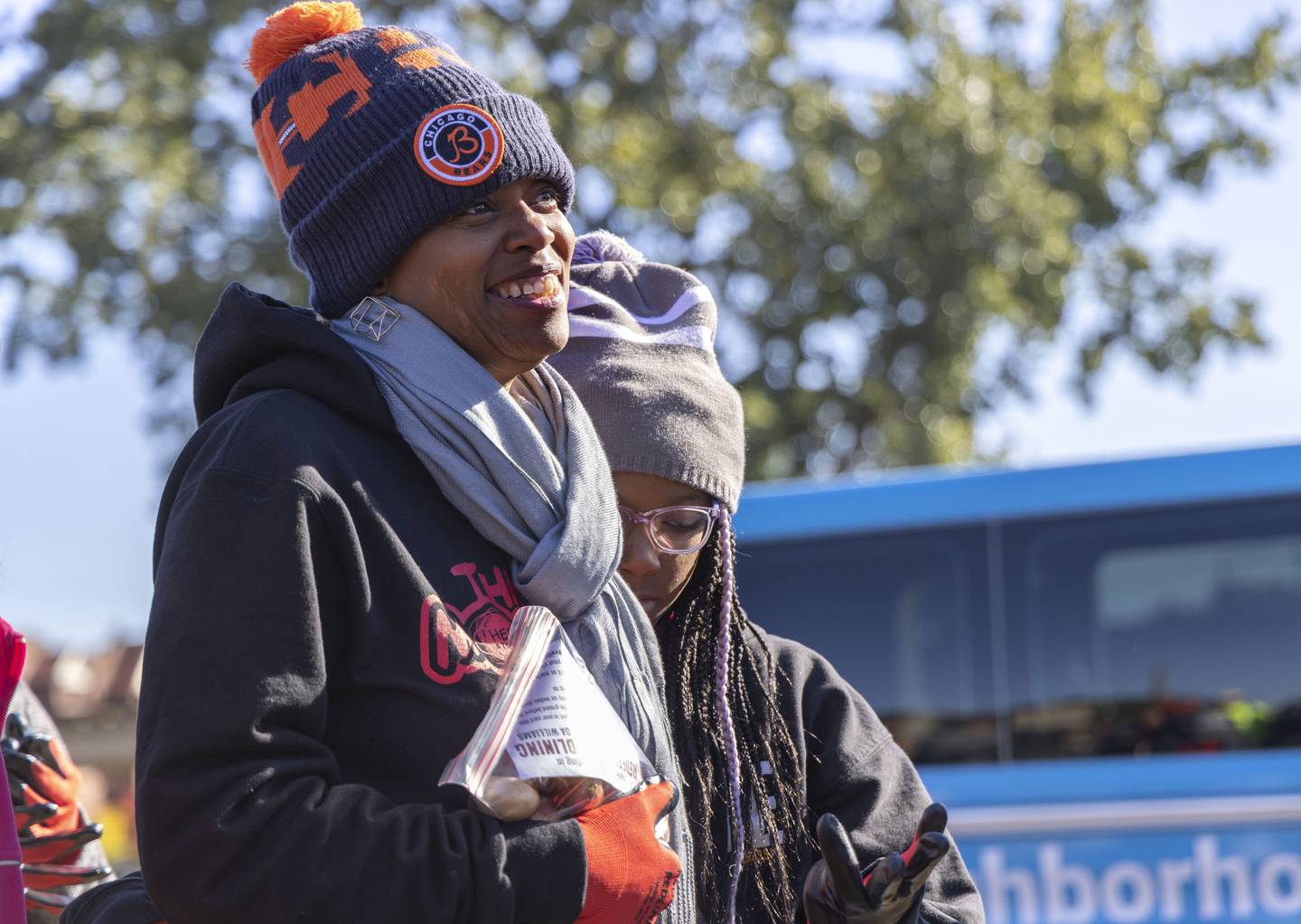
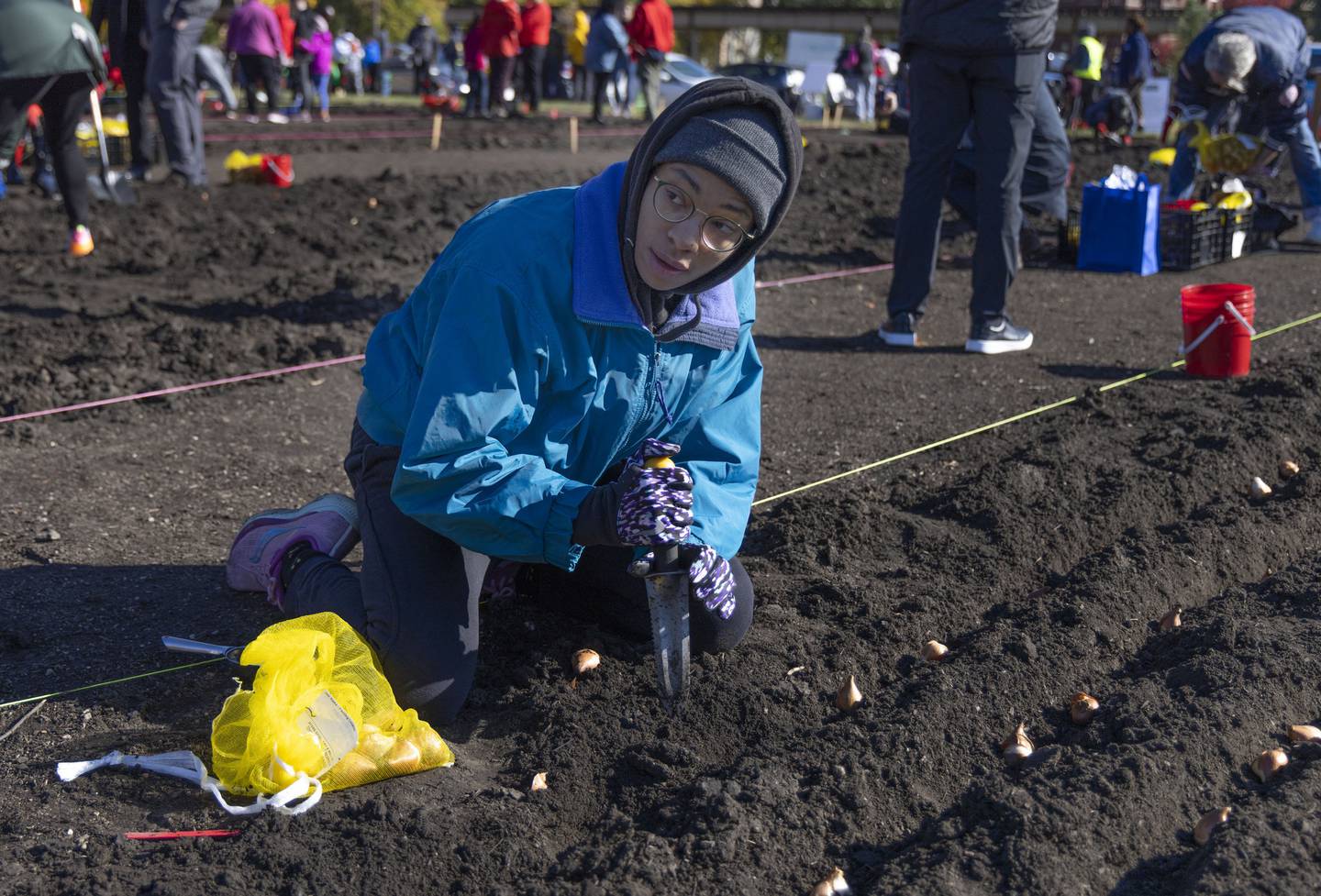
By spring, the intersection of 53rd Street and Prairie Avenue will be awash in a sea of red tulips — 6 acres of them to be exact, planted Oct. 15 by artist Amanda Williams, 2022 MacArthur grant recipient, South Side residents, and theEmerald South Economic Development Collaborative.
The neighborhood beautification is part of Williams “Redefining Redlining” project that calls attention to the effects of redlining, the practice of systematizing discrimination based on where someone lives. The practice that denied members of the Black community the chance to invest in property from 1933-1968 continues to reverberate across the country. Racially restrictive covenants made popular by the real estate industry marked certain areas as undesirable if people of color lived there. While whites could build wealth through equity in homes, redlining enforced segregation and created a wealth gap from which Blacks have yet to rebound.
Advertisement
“I’ve been thinking about this idea for five or six years … about redlining and the impact it had on our ability to shape our neighborhoods and our environment,” Williams said. “The work that I’ve been doing over several years to really interrogate the redlining maps. … I decided what might it look like to tackle redlining as a term and process a lot more literally, so that people can see and understand. So we decided to re-create the footprint of the houses and apartment buildings that should be still standing in several of these lots.
“Sadly, because of the proliferation of vacancy, you do have uninterrupted swaths of land where you can really get that visual impact of how detrimental these systemic racist policies have been to these neighborhoods. We’re filling it in with red, something that people can instantly relate to and understand.”
Advertisement
Williams has centered a lot of her work around color — from Blackness in its myriad colors in 2020 with her Instagram series called “What Black is This, You Say?” to her multiyear “Color(ed) Theory” project wherein she painted condemned South Side houses in colors such as Newport 100s teal and Crown Royal bag purple to acknowledge the racially tinted architectonic blight of Black communities.
With this latest work, she said the choice of tulips was specific, given the history and speculation around tulip bulbs in 17th century Holland. At the height of “Tulip Mania,” speculation of the value of certain rare bulbs meant they cost as much as a house at the time. That coupled with the aesthetics: the color relating to redlining, and the straight stalk and crisp edges of tulips being perfect from an artistic standpoint, brought the idea full circle.
“It seems so poetic and powerful to imagine or suggest, what it means to have 100,000 tulips, and what would that mean if we could have the value of a house for every single one of those being planted in these neighborhoods that should still be vibrant neighborhoods,” Williams said. “The confluence of all these things lead to this moment that’s going to be hugely impactful, good, bad or otherwise. 100,000 bulbs in these fields and imagining the houses, the apartments that are still there and those that get to look out the window every morning and see this idea about a field of flowers is a gesture toward how you create momentum about possibility.”
Williams said of the four lots at 53rd and Prairie, she and Ghian Foreman, president and CEO of Emerald South Economic Development Collaborative plotted out a space of 16 to 18 homes or apartment buildings for the tulips. The shock of color and the amount of flowers in one location was planned so people can understand the significance of one pin on a map as opposed to a vacant lot hereand there. “When you can see 100,000 tulips by standing in the middle of the street and spinning in a circle, the magnitude of that is a lot different,” she said.
Foreman agrees. Emerald South Development Collaborative is partnering with Williams on “Redefining Redlining” through its Terra Firma initiative. According to Foreman, the initiative launched in 2021 locally and is modeled after a pilot program in Philadelphia. Foreman said the East Coast program helped with decreasing violence and improving well-being. The premise of the Chicago initiative is similar — transforming vacant lots through clean up, fencing, and plantings in hopes of building and attracting community wealth to create better outcomes for the South Side, physically, mentally, short term and long term.
“We’re figuring out how to create this next generation and what these communities will be in the future. And we’re starting with something simple: flowers,” Foreman said. The cost of planting this amount of bulbs is $200,000. Terra Firma is a five-year, $25 million land care program meant to maintain, beautify, activate more than 200 acres of vacant South Side land — from Bronzeville to South Chicago along the lake. Foreman said we have land here to ‘dream big dreams.”
“When we do these kinds of projects, the long-term impact they have on community residents is to think about the possibilities,” Foreman said. “The Washington Park community, where we’re doing the planting, has about 8 million square feet of vacant land. For many community members, this is all they’ve ever known.
“The simple act of planting flowers and being a part of the community coming together to plant these flowers and the magic that will reveal itself in the spring, in a lot of ways is what we’re hoping for in the community. It takes some work, it takes some time. It takes some big thoughts, some outside investment. For those young people in the community who will later say, ‘I was a part of this,’ they will think big thoughts and they’ll come up with that next idea that will have a big impact on the community. We’re hoping that continues to have ripple effects far beyond what we can even think about.”
Advertisement
Foreman believes the flowers are only the beginning of a scalable and transferrable form of community engagement. Just like the bulbs blossom and go back underground during winter, the idea of possibilities is going to multiply and grow, where one neighborhood may plant mint, another lavender. Foreman also hopes that the Redlining project will draw people from around the city and they will stop, sit and savor the work and go on to support local businesses. By seeing a neighborhood not very dissimilar from their neighborhood, everyone wins and everybody can play a part.
“It’s not just the responsibility of those in this community, it’s all of our responsibility,” Foreman said. “I want people to call us and say we want to do something … let’s ideate together, let’s try to figure out how to bring in the resources that we need to get this done.
“Our communities are used to finding a way to figure it out. I hope it’s not just people from the South and West sides. I hope its people from around the city. And I hope this sparks bigger conversations about what we can do, our individual contribution to making our city better. I think a lot of it is a function of us creatively thinking about how we work together and thinking about ourselves as one collective unit. We have these artificial boundaries we call neighborhoods, but we all have the same issues.”
“What I’ve learned from color theory and the idea of what I call communal activations, as opposed to community building is that when you put what seems like low barriers of entry or low stakes kinds of gathering together for people, they form the long-lasting threads and bonds,” Williams said “The multiplicity of ways that people are going to take ownership of this work goes beyond the kind of more obvious ideas that we are talking about with homeownership or land value or landowners’ rights.
“This could do more for people who have lived near one another, but maybe never had a conversation (other) than trying to beg them to come to a town hall or an activation event in a way that they never might not necessarily feel invested in or feel like it’s too much effort. What is planting one bulb? What’s walking past the site? I also think the young people, this sparks an idea in their minds about what they can propose, what they can make happen and that people in their own neighborhood can help them facilitate that. I’m super excited to see that impact.”