




A hundred days after the U.S. Supreme Court overturned Roe v. Wade, abortions for out-of-state patients have surged in Illinois, as many Midwestern and Southern states have banned or severely restricted terminating a pregnancy.
Before the historic reversal of federal reproductive rights, Planned Parenthood of Illinois used to schedule dozens of abortion patients from other states each month. Now hundreds of patients are crossing state lines monthly to terminate a pregnancy in Illinois, the agency said.
Advertisement
“Our overall out-of-state abortion volume is 10 times what it was historically,” said Kristen Schultz, chief strategy and operations officer at Planned Parenthood of Illinois. “The need ramped up in Illinois and it has stayed consistently high.”
Roughly a dozen states nationwide — predominantly in the Midwest and South — have outlawed terminating a pregnancy in nearly all cases, leaving about 80 million people without access to abortion services, according to the New York-based Center for Reproductive Rights. Several other states have also passed earlier gestational restrictions, curbing access to abortion later in pregnancy.
Advertisement
“Illinois is in an incredibly critical position in terms of the Midwest,” said Elisabeth Smith, director of state policy and advocacy for the Center for Reproductive Rights. “All of the states that Illinois shares a border with have either no abortion access or more limited access.”
The high court’s June 24 ruling ended federal abortion protections, leaving the matter of abortion rights to be determined by individual states. Terminating a pregnancy remains legal in Illinois, which has strong reproductive rights protections amid the generally restrictive Midwest.
Illinois Right to Life Executive Director Amy Gehrke called the rising number of out-of-state patients “tragic,” noting that terminating a pregnancy “is always deadly to preborn children.”
“I believe those on both sides of the abortion debate have been surprised by just how fast the abortion numbers in Illinois have skyrocketed,” she said.
Three months after the fall of Roe, here are six things to know about the shifting reproductive rights landscape in Illinois, the Midwest and nation.
1. More abortion patients are crossing state lines to terminate a pregnancy in Illinois than ever before. Before Roe was overturned, Planned Parenthood of Illinois on average scheduled about 100 out-of-state abortion patients every month. The first week after the Supreme Court overturned the 1973 landmark case, nearly 750 patients from other states scheduled appointments to terminate a pregnancy, the agency said.
“In the last couple of months, we’ve seen a really dramatic increase in our out-of-state-abortion patients,” Schultz said.
In January, two southern Illinois abortion providers opened the Regional Logistics Center, a designated call center where case managers help traveling patients with transportation, lodging, child care and other needs. The center received 648 calls from patients in May, the month before Roe was reversed. In August, the number of calls more than tripled to 1,937, said Julie Lynn, spokeswoman for Planned Parenthood of St. Louis Region and Southwest Missouri, which covers southern Illinois.
Advertisement
2. The number of states that patients are traveling from has also increased. Under Roe, Planned Parenthood of Illinois typically saw abortion patients from 10 or 15 states in addition to Illinois each month, Schultz said.
“Since Roe fell, we’ve seen abortion patients from 28 states outside of Illinois,” she said.
Many of those patients have been coming from Wisconsin and Ohio, Schultz said.
“But we’re also seeing more patients than ever from Tennessee and Missouri, and even faraway places like Texas and Alabama, Louisiana Mississippi and Florida,” she said. “It’s emotionally taxing both for the patient and for the staff that are supporting them. They are coming to us and calling us with fear and anxiety and financial needs and logistic needs that are unique to every single patient. There’s more than we expected and it’s deeper than we expected.”
3. In southern Illinois, patients have to wait longer to schedule an abortion appointment. Before June 24, when abortion was still legal nationwide, a patient could schedule an abortion appointment in three or four days at the Planned Parenthood clinic in Fairview Heights, near the border of Missouri. In July, the clinic said abortion appointments were taking three weeks or more to schedule.
Now wait times are generally between two-and-a-half to three weeks, Lynn said. Earlier in September, the clinic expanded its hours on weekdays to help accommodate the influx in patients and keep wait times down, she added.
Advertisement
Wait times haven’t significantly increased throughout the rest of the state, though it might take a few extra days to schedule an appointment, according to Planned Parenthood of Illinois, which has 17 clinics statewide, predominantly in the Chicago area.
4. Abortion was briefly banned in Indiana but is now legal again. In August, Indiana became the first state to pass a near-total ban on abortion after the reversal of Roe. All seven of the state’s clinics had to cease providing abortion services in mid-September.
But a week later, a county judge granted a preliminary injunction temporarily blocking the ban, which abortion clinic operators argued violates the state constitution.
Antonio Marchi, executive director of Right to Life Michiana, said he hopes the state’s abortion ban will prevail.
“As abortion clinics in the state work to resume operations, we will continue to reach out, educate and advocate for vulnerable mothers and their pre-born children,” he said. “This is not the first setback we have experienced in the courts, so the challenges are not surprising. The pro-life movement has always been in it for the long haul.”
Indiana clinics were permitted to resume offering abortions, but some providers said it can be difficult to suspend services and then quickly restore them amid so much legal uncertainty.
Advertisement
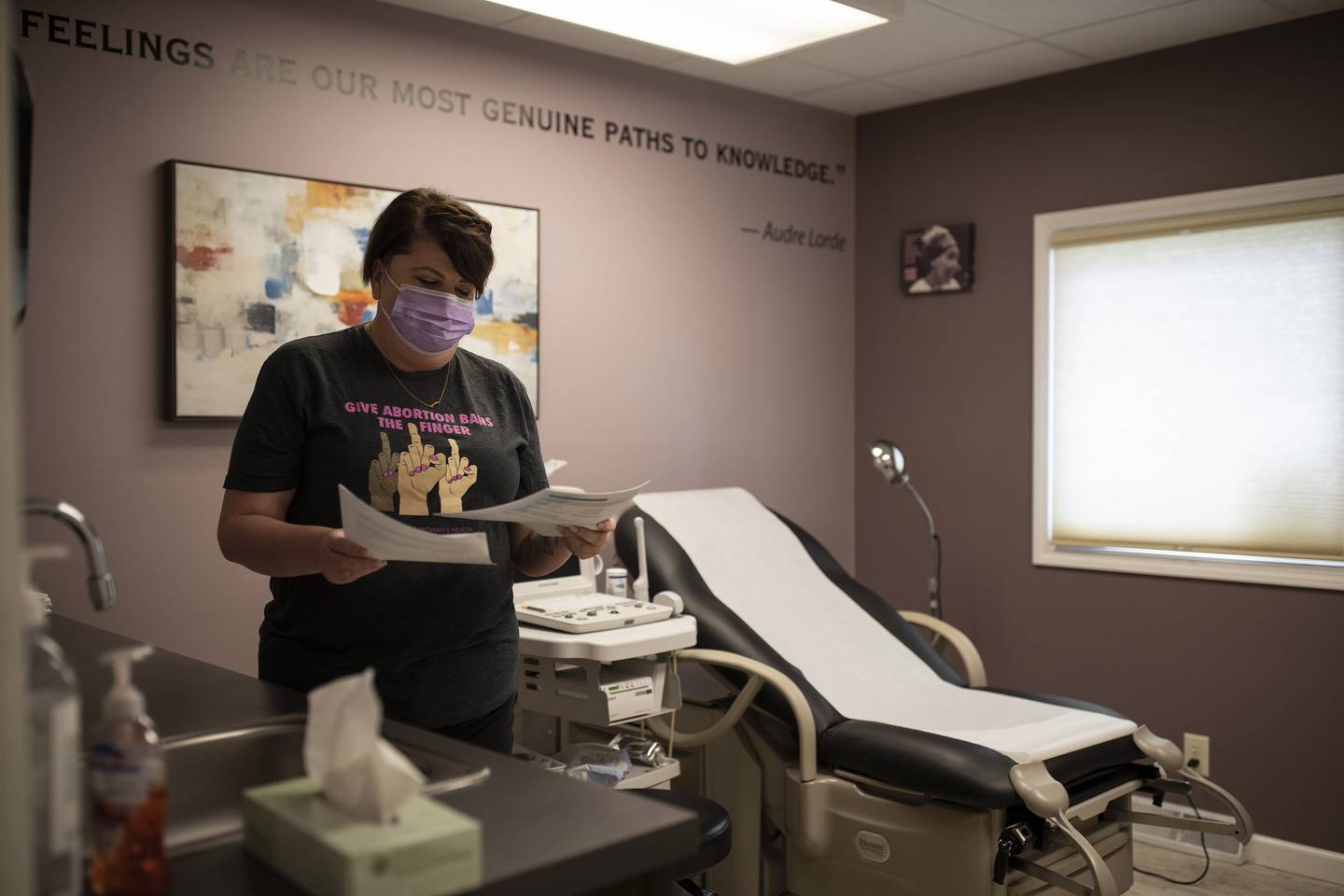
Officials at Whole Woman’s Health of South Bend said the clinic is planning to provide abortions again “in the near future.”
“Of course, this landscape of legal back-and-forth leads to disruption in patient care and uncertainty for our staff,” said Amy Hagstrom Miller, president and CEO of Whole Woman’s Health. “That is exactly what is intended by the politicians who pass bans like this one.”
5. New abortion clinics are coming to Illinois. Choices Center for Reproductive Health plans to open a clinic in Carbondale in October, adding a third option for abortion services in southern Illinois.

Afternoon Briefing
Daily
Chicago Tribune editors’ top story picks, delivered to your inbox each afternoon.
Choices, which is based in Memphis, had to stop performing abortions in Tennessee when a state ban went into effect in August.
“Our new Carbondale clinic will allow us to continue to provide essential abortion care for folks in our communities,” Choices said on its website. “A three-hour drive from Memphis and Nashville and a stop on the Amtrak line, this facility will be the southernmost abortion provider in Illinois, a lifeline for people in the Southeast who need an abortion.”
A Wisconsin physician over the summer bought two Rockford buildings, with plans to turn the sites into abortion clinics. Providers in Wisconsin suspended abortion services as of June 24, due to an 1849 state law that prohibits terminating a pregnancy. The statute had not been enforced for decades due to Roe, but remained on the books. Wisconsin Attorney General Josh Kaul and Gov. Tony Evers have challenged the state abortion ban, calling it “archaic.”
Advertisement
Planned Parenthood of Illinois also added space and expanded services at its Champaign Health Center, the agency announced recently. The central Illinois provider now offers in-clinic procedures as well as medication abortions. Building renovations added 5,000 square feet to the health center, which includes more procedure rooms, waiting rooms, ultrasound rooms, a recovery room and a lab.
6. Nationwide, about 50 clinics have ceased performing abortions, according to the Center for Reproductive Rights. Some of these clinics have closed, some have moved to states where abortion is legal, and others have stayed open and continued to offer other health services but no longer provide abortions.
“We’ve known for a long time that once a clinic closes, it’s really difficult to reopen and resume services,” Smith said.
eleventis@chicagotribune.com