


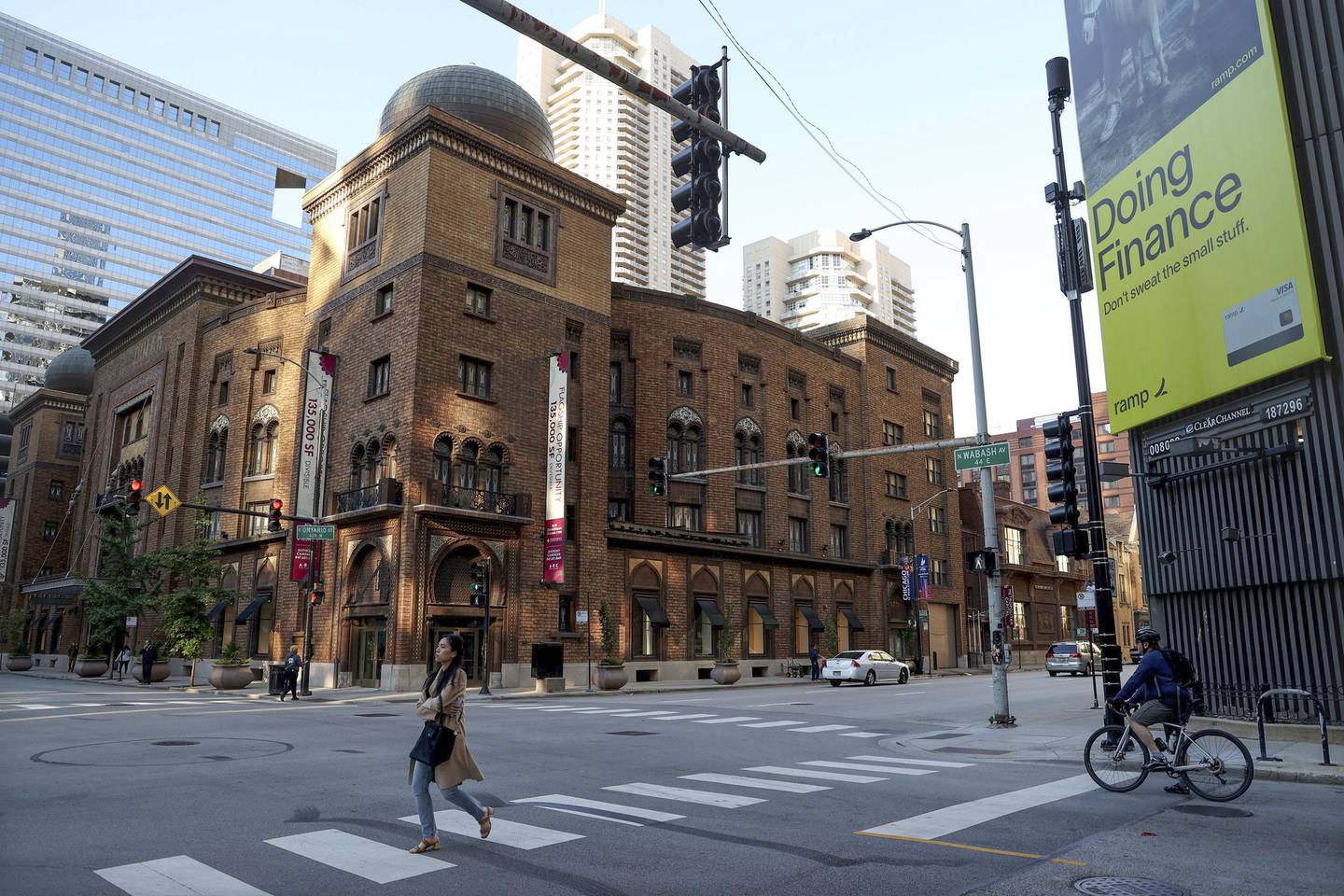
Despite the concerns of the local alderman and neighborhood groups, Chicago officials say a new study — paid for by the city’s chosen casino developer — gives them confidence that River North can handle increased traffic slated for the proposed Bally’s temporary casino at Medinah Temple.
The second traffic impact study of the area released today gives “further final evidence that this is something that we think from a traffic point of view can be accommodated in the River North area,” said Chicago Department of Transportation Managing Deputy Commissioner Kevin O’Malley.
Advertisement
The study was commissioned by Bally’s — the company selected by Mayor Lori Lightfoot to develop the permanent casino in River West — and completed by V3 companies and Fish Transportation Group.
The study estimates the temporary casino would generate 462 trips during the weekday evening commuter peak hour, between 4 p.m. and 6 p.m., and 516 during the Friday evening casino peak hours of 8 p.m. to 11 p.m., both inbound and outbound.
Advertisement
Bally’s and city officials are planning on the proposed temporary casino opening up next year at the massive, landmarked structure bordered by Ontario, Ohio and State streets and Wabash Avenue. The temple has been vacant for more than two years, and O’Malley acknowledged it’s difficult to know how patterns might change as Chicago continues to emerge from the pandemic.
The study looked at traffic and the availability of parking on a Thursday and Friday this past May.
Local Ald. Brendan Reilly, 42nd, previously criticized the city for not making such studies available ahead of final casino hearings. Locating a temporary casino there was a “horrible” idea, Reilly argued in May. He and others were caught off guard by a last-minute switch in the proposed site of the temporary casino, from a building on the Freedom Center, a Tribune printing facility , west of the river to the middle of one of the most dense, busy areas of the city.
Deborah Gershbein, president the Streeterville Organization of Active Residents, said earlier this year that members were “very, very surprised” to learn of the temporary casino plans “because it is such a congested area already, and I just can’t imagine how it would accommodate the additional traffic.”
Even Bally’s chairman Soo Kim said Medinah’s lack of dedicated parking was one of its biggest drawbacks but it was one of the only economically feasible locations where he could land a deal.
The study suggests Kim shouldn’t be concerned: “Based on the completed parking observations, there is adequate parking in the area to accommodate this demand,” the report said.
While there is no on-site parking at the temple itself, there are roughly 5,000 spaces available in garages at nearby buildings. At its peak, demand on spaces from casino patrons and employees would be approximately 500, the report estimates: 450 for patrons and 50 for workers. In mid-May, when the study team made its observations, there were roughly 850 open spaces in nearby buildings at peak times.
But key to preventing congestion will be a well-oiled valet operation, quick drop-offs and pick-ups for patrons taking Ubers, Lyfts, cabs and space for charter buses. There will be designated areas for each, O’Malley said.
Advertisement
Sign up for The Spin to get the top stories in politics delivered to your inbox weekday afternoons.
The report recommends the valet operation be provided along the Ohio Street frontage adjacent to the temple, where there’s enough space for six to eight vehicles. Lyft and Uber drop-offs are recommended just west of there on Ohio, and charter buses drop-off is recommended along the west side of Wabash, which could fit four or five charter buses for short-term loading and unloading.
The city will require traffic control aides “at many of their intersections in, around the area to manage all that, to make sure pedestrians can move in and out of there, making sure traffic moves along as well as shushing out all those double-parkers and other kinds of activities,” O’Malley said. “We think we have enough resources in place here, from what they’re proposing to keep that manageable.”
Bally’s “has not yet determined parking pricing for valet operations,” the report says, but “they would be open to discussions with CDOT staff about developing a pricing differential between self-park and valet to encourage self-park to minimize the curbside valet volumes.”
At full capacity, the casino can welcome roughly as many guests as The Vic Theater, O’Malley said. The theater has 1,000 seats and a maximum capacity of 1,400, according to its operator’s website, while Medinah Temple has a maximum capacity of 1,500 people and 1,100 planned “gaming positions.”
Not all of the visitors or staff will drive, the study pointed out — the temple is accessible via several CTA bus lines, and the red line Grand stop is about a block away. The area is also home to many hotels where gamblers could walk over.
Advertisement
“We don’t think it’ll add any kind of congestion to either people trying to go to the casino or anybody trying to visit or go to any of the areas around there. It will be something that’s very familiar and common in entertainment areas in the city,” O’Malley told the Tribune. “This is something that we’re very used to and it will not be a problem.”
The study points to “barely any degradation” in wait times for existing drivers, O’Malley added. There are no plans to change the timing of traffic lights nearby, he said.
“The addition of the projected temporary casino trips during the weekday pm commuter peak hour and the Friday pm casino peak hour result in slight increases in delay,” the report says, but still with an average wait time of less than 35 seconds or less.